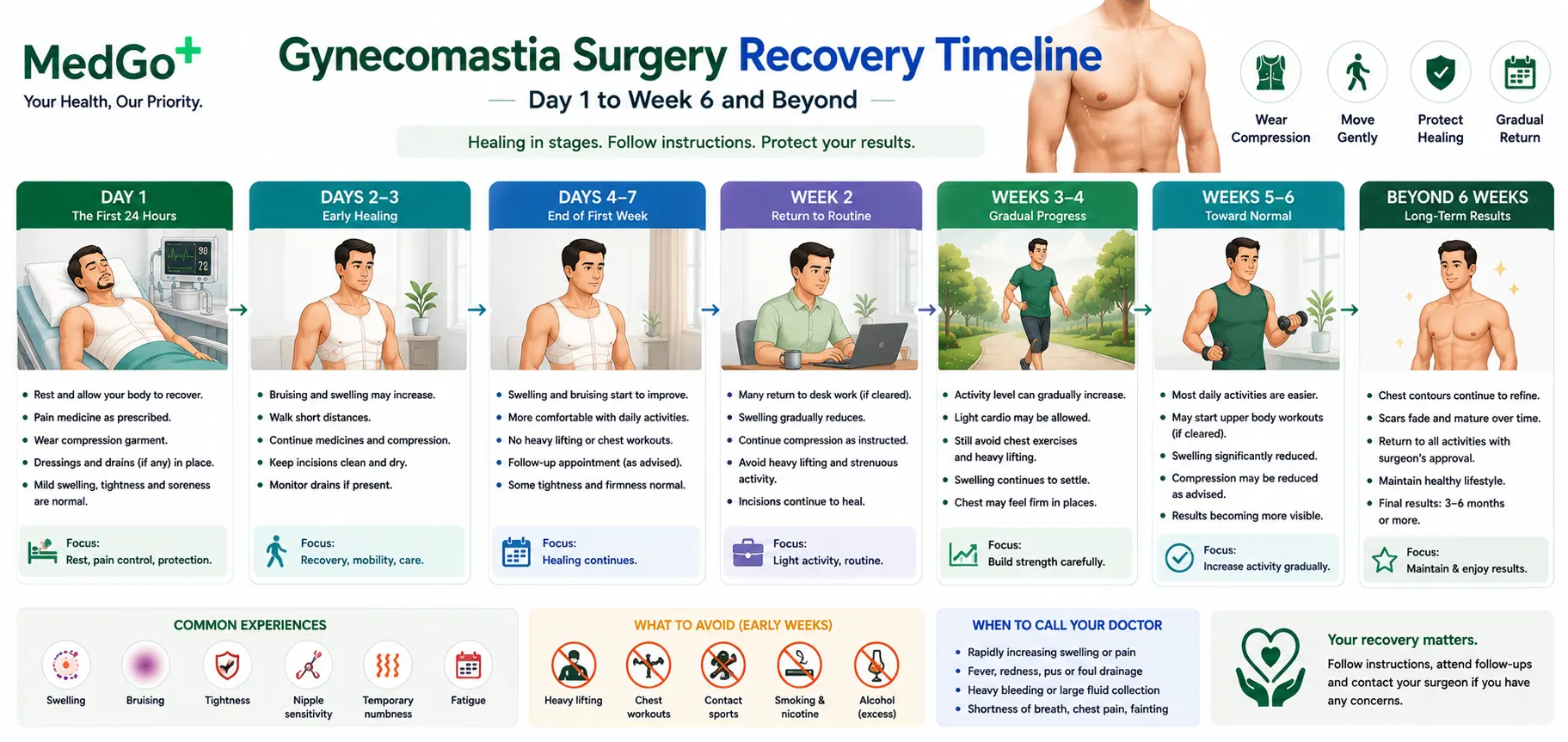
Recovery after gynecomastia surgery is a gradual process. The first few days are mainly about controlling pain and swelling, protecting the surgical area and allowing your body to recover from anesthesia. Over the following weeks, activity is gradually increased while swelling and tissue firmness continue to settle.
The exact recovery timeline depends on what was done during surgery. Someone who had liposuction alone may recover faster than someone who required glandular tissue removal, extensive skin excision or a combination procedure.
The timeline below is a general guide. Your own surgeon’s instructions should always take priority because they know exactly what was done during your operation.
Gynecomastia Surgery Recovery at a Glance
- Day 1: Rest, pain control, compression and monitoring.
- Days 2–3: Gentle movement, continued compression and wound care.
- Days 4–7: Bruising and swelling remain but early mobility usually improves.
- Week 2: Many patients begin returning to light daily activities and work depending on the procedure.
- Weeks 3–4: Swelling gradually settles and activity can usually increase with surgeon approval.
- Weeks 5–6: Many patients are approaching normal activity, although heavy exercise may still require clearance.
- Months 2–6+: Chest contour continues to settle and scars gradually mature.
What Determines How Fast You Recover?
There is no single recovery timeline that applies to every gynecomastia patient. Your recovery depends on several factors.
- Whether you had liposuction alone.
- Whether glandular tissue was surgically removed.
- Whether excess skin was removed.
- The amount of tissue treated.
- Whether drains were placed.
- Your general health.
- Smoking or nicotine use.
- Your body’s individual healing response.
- The type of work and physical activity you normally perform.
- Whether any postoperative complication develops.
Day 0: The Day of Gynecomastia Surgery
After surgery, you will be moved to a recovery area where your vital signs, pain level and overall condition are monitored as you recover from anesthesia.
- You may feel sleepy or tired after anesthesia.
- Your chest will usually be covered with dressings or a compression garment.
- Drains may be present depending on your procedure.
- Mild to moderate discomfort is expected.
- Swelling and bruising may begin developing.
- Pain medicine may be provided or prescribed.
- You will receive instructions about wound and drain care.
- You will be told when to return for follow-up.
Many uncomplicated gynecomastia procedures are performed as outpatient surgery, allowing the patient to go home after adequate recovery from anesthesia and appropriate postoperative assessment.
Day 1: The First 24 Hours
The first 24 hours are primarily about rest, protection of the surgical area and keeping symptoms under control.
- Rest and avoid unnecessary physical activity.
- Take prescribed medicines exactly as directed.
- Wear the compression garment according to your surgeon’s instructions.
- Walk gently around the home if your surgeon allows it.
- Keep the dressings and incisions protected as instructed.
- Do not drive while affected by anesthesia or prescription pain medicines.
- Have a responsible adult available to help you if required.
Some patients experience tightness across the chest because of swelling and compression. This can be uncomfortable but is commonly part of early recovery.
Days 2–3: Early Healing
During the next few days, bruising and swelling may become more noticeable before they begin to improve. This does not necessarily mean that something is wrong.
- Continue wearing your compression garment as prescribed.
- Continue prescribed medicines.
- Take short, gentle walks.
- Avoid lifting heavy objects.
- Avoid stretching the chest forcefully.
- Keep the surgical wounds clean and protected according to instructions.
- Monitor drains if you have them.
- Attend an early follow-up if your surgeon has scheduled one.
Your chest may look uneven at this stage because swelling can be greater on one side than the other.
Days 4–7: End of the First Week
By the end of the first week, many patients begin to feel more comfortable. Bruising may still be visible and swelling will usually remain.
- Continue compression if prescribed.
- Continue gentle walking.
- Avoid strenuous exercise.
- Avoid heavy lifting.
- Follow wound-care instructions.
- Continue monitoring for increasing swelling or drainage.
- Attend follow-up appointments as scheduled.
Some patients can return to desk-based work within several days to around two weeks, but the appropriate timing depends on the procedure and the physical demands of the job.
Week 1: What Is Normal?
- Swelling.
- Bruising.
- Chest tightness.
- Mild to moderate soreness.
- Temporary numbness or altered nipple sensation.
- Firm areas beneath the skin.
- Mild asymmetry during healing.
- Fatigue or reduced energy.
Do not judge the final surgical result during the first week. The tissues are still inflamed and swollen.
Week 2: Returning to Daily Life
During the second week, many patients notice meaningful improvement in pain and mobility. Swelling and bruising should generally begin to settle, although the chest will not yet look completely healed.
- Continue compression according to your surgeon’s instructions.
- Increase normal walking gradually.
- Return to desk-based work if cleared.
- Continue avoiding heavy lifting.
- Avoid chest workouts unless specifically cleared.
- Continue wound and scar care as instructed.
Some surgeons allow light cardiovascular activity around this stage, while others recommend waiting longer. Your surgical technique and healing should determine the decision.
Week 3: Swelling Begins to Settle
By the third week, many patients feel substantially better, but the chest may still feel firm or uneven in places.
- Bruising should continue fading.
- Swelling should gradually decrease.
- Tenderness usually becomes less noticeable.
- Numbness may still be present.
- The chest may feel firm under the skin.
- Daily activities can usually become easier.
Do not assume that persistent firmness at three weeks means the surgery has failed. Healing tissue and postoperative swelling can remain firm for considerably longer.
Week 4: Increasing Activity
Around four weeks, many patients are able to increase activity substantially if healing has been uncomplicated and their surgeon has cleared them.
- Normal walking should generally be comfortable.
- Many routine daily activities can be resumed.
- Light exercise may be allowed depending on your surgeon’s protocol.
- Upper-body exercise may still need restrictions.
- Heavy lifting should only resume when cleared.
- Continue compression if your surgeon has prescribed it for longer.
Upper-body and chest exercises are particularly important to reintroduce gradually because they place direct stress on the healing tissues.
Weeks 5–6: Returning Toward Normal Activity
By five to six weeks, many patients are approaching normal daily activity. However, clearance for weight training, chest exercises and contact sports should still come from the surgeon who performed the operation.
- Swelling should be significantly reduced compared with the first weeks.
- Bruising should generally have resolved or become minimal.
- The chest contour becomes easier to appreciate.
- Nipple sensation may still be changing.
- Scars remain immature and may be pink or firm.
- Some patients can gradually resume heavier exercise after medical clearance.
Do not rush the final stage of recovery simply because you feel better. The tissues may still be remodeling beneath the skin.
Months 2–3: The Chest Continues to Settle
The second and third months are often when the chest begins to look increasingly natural. Residual swelling and firmness can continue to improve.
- The chest contour becomes more defined.
- Firm postoperative areas may soften.
- Numbness may gradually improve.
- Scars begin to mature.
- Residual swelling continues to decrease.
Some patients reach a very satisfactory appearance within a few months, while others continue to see gradual changes for longer.
Months 3–6: Approaching the Long-Term Result
By three to six months, much of the postoperative swelling should have settled, although individual healing varies.
This is when the final chest contour becomes easier to assess. Scar tissue may continue softening and scars may gradually become less noticeable.
Some patients may continue to experience subtle changes beyond six months, particularly after more extensive surgery.
Gynecomastia Surgery Recovery: Pain Timeline
Pain is usually greatest during the early postoperative period and tends to improve as swelling settles.
- First few days: soreness, tightness and tenderness are common.
- End of Week 1: discomfort is usually improving.
- Week 2: many patients experience substantially less pain.
- Weeks 3–4: occasional tenderness or tightness may remain.
- After several weeks: persistent or worsening pain should be discussed with the surgeon.
Pain that suddenly becomes severe or increases after initially improving should not be ignored.
Gynecomastia Surgery Swelling Timeline
Swelling is one of the most common reasons patients become worried about their appearance after surgery. It can make the chest look larger, uneven or irregular during the first several weeks.
- Days 1–7: swelling is commonly prominent.
- Week 2: swelling usually begins to decrease.
- Weeks 3–6: the contour progressively becomes clearer.
- Months 2–3: residual swelling continues settling.
- Months 3–6+: remaining swelling may continue to improve.
Final results should not be judged while substantial postoperative swelling remains.
Why Does My Chest Feel Hard After Gynecomastia Surgery?
Firmness after surgery can occur because of swelling, healing tissue and scar formation beneath the skin.
This firmness can persist for weeks or months and often gradually softens as the tissues remodel.
However, a new or rapidly enlarging hard area, especially when accompanied by pain, redness or significant swelling, should be assessed by your surgeon.
Compression Garment After Gynecomastia Surgery
A compression vest is commonly used after gynecomastia surgery to support the healing chest, control swelling and help the tissues settle into their new contour.
There is no single universal schedule for every patient. Some surgeons recommend continuous wear initially and gradually reduce the duration over subsequent weeks.
- Wear the garment exactly as instructed.
- It should provide support without causing severe pain or breathing difficulty.
- Keep the garment clean according to the manufacturer and surgeon instructions.
- Check the skin regularly for irritation.
- Do not independently stop compression earlier than recommended.
ASPS notes that compression garments may be used for several weeks after gynecomastia surgery, but the exact duration varies by surgeon and procedure.
How Long Do I Need to Wear the Compression Vest?
Many surgeons recommend compression for several weeks. Some protocols use around four to six weeks or longer depending on the operation and the patient’s swelling.
Do not use another patient’s compression schedule as your own. Your surgeon may adjust the duration depending on swelling, skin quality, drains and the type of surgery performed.
Drains After Gynecomastia Surgery
Not every patient needs drains. When drains are used, they allow blood or other fluid to leave the surgical area while the tissues heal.
The duration varies according to drainage volume and the surgeon’s protocol. Some patients have drains removed within a few days, while others may need them for longer.
- Keep the drain secured.
- Record drainage if instructed.
- Do not pull or disconnect the drain yourself.
- Report sudden changes in drainage or significant bleeding.
- Attend the scheduled drain-removal appointment.
When Can I Shower After Gynecomastia Surgery?
The timing of your first shower depends on the type of dressing, incision closure and whether you have drains.
Some patients with uncomplicated incisions may be allowed to shower within a few days, while patients with larger wounds or drains may receive different instructions.
- Follow your surgeon’s specific shower instructions.
- Do not soak the wounds in a bath unless cleared.
- Avoid swimming until your wounds are fully healed and your surgeon allows it.
- Do not scrub healing incisions.
- Pat the area dry rather than rubbing it.
How Should I Sleep After Gynecomastia Surgery?
Many surgeons recommend sleeping on your back during the early recovery period to avoid direct pressure on the chest.
- Sleep in a comfortable position that does not compress the surgical area.
- Use pillows to support your upper body if recommended.
- Avoid sleeping directly on your chest.
- Follow your surgeon’s instructions if your procedure was extensive.
You can gradually return to your preferred sleeping position when your surgeon confirms that the tissues have healed sufficiently.
When Can I Drive After Gynecomastia Surgery?
Do not drive while you are affected by anesthesia, sedating medicines or prescription pain medication that impairs alertness.
You should also be able to control the vehicle safely without significant pain or restricted arm movement before driving.
Ask your surgeon when you are medically ready to drive, particularly if your operation involved extensive tissue removal.
When Can I Return to Work?
Return-to-work timing depends on the procedure and the physical demands of your job.
- Desk-based work: often possible within several days to around two weeks if recovery is uncomplicated.
- Jobs requiring moderate physical activity: may require additional recovery time.
- Heavy manual work: may require several weeks before clearance.
- Jobs involving repetitive upper-body movement: require individualized advice.
Do not return to physically demanding work simply because your pain has improved. Internal tissues may still be healing.
When Can I Exercise After Gynecomastia Surgery?
Exercise should be restarted gradually. Walking is generally encouraged early, but strenuous exercise and upper-body workouts need to wait until the surgeon confirms that healing is adequate.
Walking
Gentle walking is commonly encouraged during early recovery to maintain mobility and circulation.
Cardio
Light cardiovascular exercise may be introduced after the initial recovery period when approved by your surgeon.
Weight Training
Heavy lifting should wait until the surgical team confirms that the tissues have healed sufficiently.
Chest Workouts
Push-ups, bench press, chest fly exercises and other direct chest workouts should be reintroduced gradually and only after clearance.
Why Should I Avoid Chest Exercises Early?
Chest exercises place mechanical stress on tissues that have recently undergone liposuction, gland removal or skin surgery.
Returning too aggressively can increase discomfort and swelling and may interfere with healing.
ASPS patient guidance commonly recommends restricting upper-body exercise for several weeks, with exact timing individualized to the procedure and recovery.
Gynecomastia Surgery Scars During Recovery
Scars change considerably during healing. Early scars may appear red, pink, raised or firm before gradually becoming softer and less noticeable.
- Do not pick at healing wounds.
- Protect scars from excessive sun exposure.
- Use silicone products only when recommended by your surgeon.
- Do not massage fresh incisions unless instructed.
- Attend follow-up appointments so scar healing can be assessed.
Scar maturation can continue for many months and sometimes up to a year or longer.
Numbness After Gynecomastia Surgery
Temporary numbness around the nipple, areola or chest can occur after surgery because small nerves are affected during tissue removal and healing.
Sensation may gradually return over weeks or months. Some patients may have longer-lasting or permanent changes in sensation.
Do not repeatedly test numb areas with extreme heat or cold because reduced sensation can make burns or injuries easier to miss.
Can I Massage My Chest After Gynecomastia Surgery?
Do not begin chest massage automatically. Some surgeons recommend specific massage techniques during later healing, while others do not.
Massage should only begin when your surgeon confirms that the incisions and underlying tissues are ready.
Diet During Gynecomastia Recovery
There is generally no permanent special diet after gynecomastia surgery. During recovery, focus on balanced nutrition that provides adequate protein, vitamins, minerals and fluids.
- Eggs.
- Fish or chicken.
- Dal and lentils.
- Curd or yogurt if tolerated.
- Paneer or tofu.
- Fruits.
- Vegetables.
- Whole grains.
- Adequate fluids.
Avoid excessive alcohol during the early recovery period, particularly while taking prescription medicines.
What Should I Avoid During Recovery?
- Heavy lifting before clearance.
- Chest workouts before clearance.
- Contact sports during early healing.
- Smoking and nicotine use.
- Alcohol while taking interacting medicines.
- Swimming or soaking before wounds are healed.
- Pressure or trauma to the chest.
- Tight clothing that irritates the incision.
- Self-directed massage or scar treatment before clearance.
- Ignoring increasing swelling, pain or drainage.
Warning Signs During Gynecomastia Recovery
Some swelling, bruising and discomfort are expected. The following symptoms, however, should prompt you to contact your surgical team.
- Rapidly increasing swelling on one side or both sides.
- Severe or worsening pain.
- Persistent or heavy bleeding.
- Increasing redness around the incision.
- Pus or foul-smelling drainage.
- Fever or chills.
- Wound separation.
- Significant change in nipple or skin color.
- Sudden shortness of breath.
- Chest pain.
- Unusual heartbeat.
- Severe dizziness or fainting.
When Is Emergency Care Needed?
Seek urgent medical attention for severe difficulty breathing, chest pain, fainting, rapidly worsening swelling or significant uncontrolled bleeding.
These symptoms should not be managed by waiting for your next routine follow-up appointment.
When Should I See My Surgeon After Surgery?
Follow-up timing varies between surgeons and procedures. Early follow-up may be needed to inspect the incisions, assess swelling, check drains and make sure healing is progressing normally.
- Attend every scheduled postoperative appointment.
- Bring questions about pain, swelling or activity restrictions.
- Ask before changing compression instructions.
- Ask before restarting exercise.
- Report new or worsening symptoms rather than waiting.
Why Does My Chest Look Worse Before It Looks Better?
This is one of the most common concerns after gynecomastia surgery. Immediately after surgery, swelling, bruising, dressings and tissue firmness can make the chest look larger or less even than expected.
The early appearance is not the final result. As swelling decreases and the tissues remodel, the chest contour generally becomes clearer.
This process can continue for several months.
When Will I See My Final Gynecomastia Surgery Result?
Most patients see significant improvement well before the final result, but complete settling takes time.
- First few weeks: swelling and bruising dominate the appearance.
- Weeks 4–6: the contour becomes increasingly visible.
- Months 2–3: residual swelling and firmness continue improving.
- Months 3–6: the chest usually approaches a more mature result.
- Beyond 6 months: subtle scar and tissue changes may continue.
Cleveland Clinic notes that patients may not see the full result for around three to six months because swelling and tissue healing take time.
A Practical Recovery Checklist
- Take prescribed medicines as instructed.
- Wear your compression garment according to your surgeon’s plan.
- Keep incisions clean and protected.
- Monitor drains if present.
- Walk gently during early recovery.
- Avoid heavy lifting until cleared.
- Avoid chest exercises until cleared.
- Eat a balanced, protein-rich diet.
- Do not smoke or use nicotine during recovery.
- Attend all follow-up appointments.
- Protect healing scars from excessive sun exposure.
- Contact your surgical team if symptoms worsen.
Recovery Timeline: Quick Reference
Day 1
Rest, pain control, compression, wound protection and gentle movement.
Days 2–3
Bruising and swelling may become more noticeable. Continue compression and gentle walking.
Days 4–7
Early mobility improves. Continue avoiding strenuous activity.
Week 2
Many patients can gradually return to light daily activities and work if cleared.
Weeks 3–4
Swelling continues to decrease. Activity can gradually increase according to medical clearance.
Weeks 5–6
Many patients approach normal activity, but heavy lifting and chest workouts should only resume after clearance.
Months 2–6
The chest continues to settle, scars mature and the long-term contour becomes clearer.
How MedGoPlus Can Help
Recovery can raise many questions: Is the swelling normal? When can I exercise? How long should I wear the compression garment? Is this firmness expected? When should I contact my surgeon?
MedGoPlus can help patients connect with qualified healthcare professionals for postoperative guidance, follow-up consultations and answers to recovery-related concerns through available consultation services.
If you develop severe pain, rapidly increasing swelling, significant bleeding, chest pain or difficulty breathing, seek prompt medical attention rather than relying only on online guidance.
The Bottom Line
Gynecomastia surgery recovery is a gradual process. The first week is mainly about rest, wound protection, compression and controlling pain and swelling. During Weeks 2–6, most patients progressively return to normal daily activities while continuing to protect the healing chest.
Do not judge your final result too early. Swelling, bruising, firmness and temporary numbness can persist for weeks or months. The chest contour generally becomes clearer as the tissues settle.
The safest recovery strategy is simple: follow your surgeon’s instructions, increase activity gradually, attend follow-up appointments and report symptoms that are worsening rather than improving.
Medical Disclaimer
This article is intended for general health education and does not replace individualized medical advice. Gynecomastia surgery techniques and postoperative instructions vary according to the procedure, patient health and surgeon preference. Always follow the instructions provided by your surgeon and healthcare team.
Take Control of Your Health with MedGoPlus
Book doctor consultations, manage your health needs, and access convenient healthcare services anytime, anywhere with the MedGoPlus App.
Scan to download
Download the MedGoPlus App