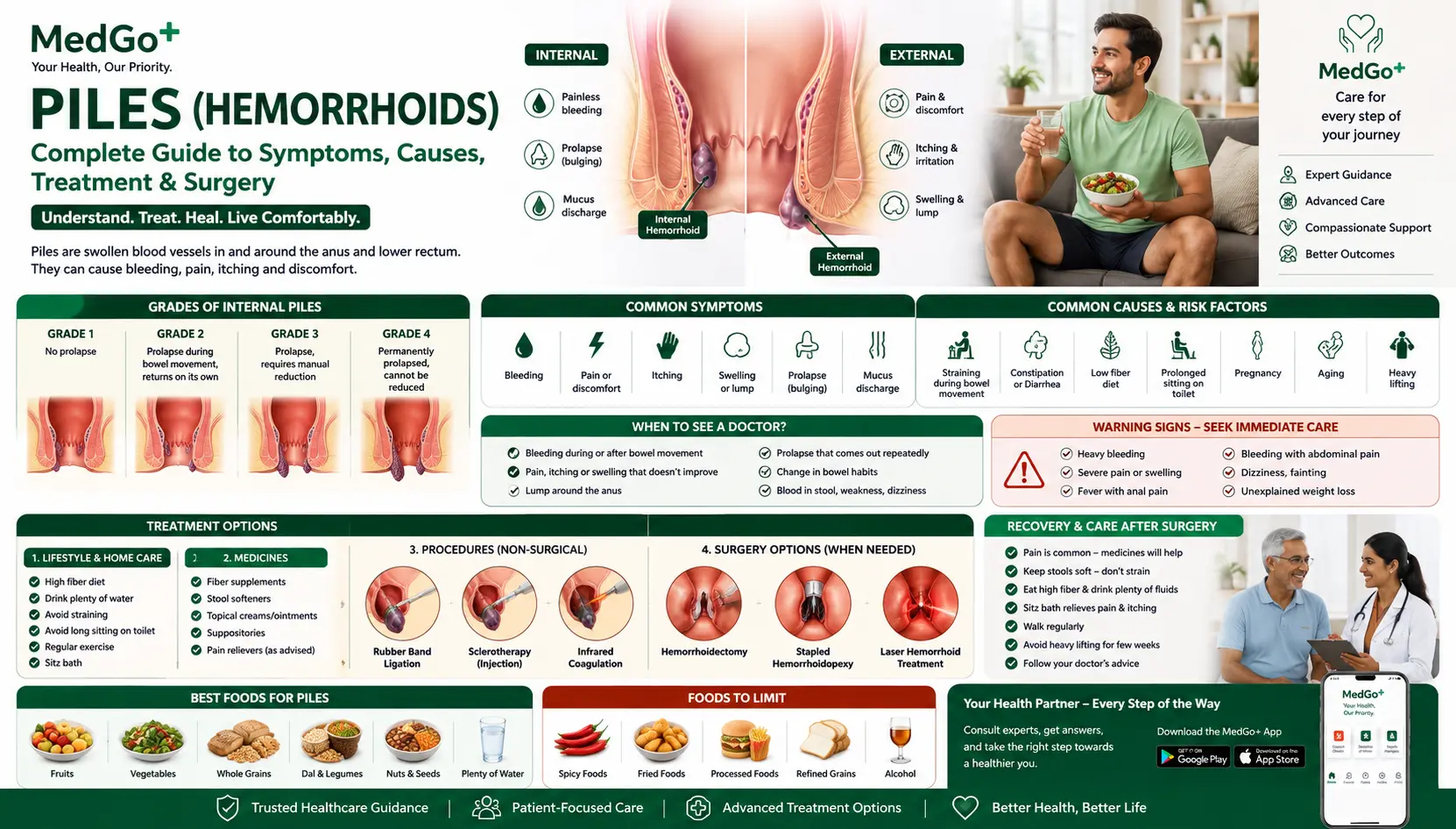
Piles, medically called hemorrhoids, are swollen and inflamed vascular cushions in and around the anus and lower rectum. They are common and can cause symptoms such as bleeding, itching, swelling, discomfort or a lump around the anus.
Piles are often associated with constipation, straining during bowel movements, prolonged sitting on the toilet and a low-fibre diet. Many patients improve with changes in diet and bowel habits, while others may need medicines, an office procedure or surgery depending on the type and severity of the hemorrhoids.
An important point is that rectal bleeding should not automatically be assumed to be caused by piles. Other conditions can also cause bleeding, so persistent or unexplained bleeding should be evaluated by a healthcare professional.
What Are Piles (Hemorrhoids)?
Hemorrhoids are vascular cushions located in the anal canal. They become a medical problem when these tissues become enlarged, irritated, prolapsed or thrombosed and cause symptoms.
The two main types are internal hemorrhoids and external hemorrhoids.
Internal Hemorrhoids
Internal hemorrhoids develop inside the anal canal. They commonly cause painless bright-red rectal bleeding and may protrude through the anus when they become prolapsed.
External Hemorrhoids
External hemorrhoids develop under the skin around the anus. They may cause itching, discomfort, swelling or a tender lump. If a blood clot forms inside an external hemorrhoid, it is called a thrombosed external hemorrhoid and can cause sudden significant pain.
What Causes Piles?
Piles can develop when pressure and strain affect the veins and supporting tissues around the anus and lower rectum.
- Straining during bowel movements.
- Chronic constipation.
- Chronic diarrhea.
- A low-fibre diet.
- Sitting on the toilet for long periods.
- Pregnancy.
- Age-related weakening of supporting tissues.
- Frequent heavy lifting.
- Repeated pressure around the anal area.
What Are the Symptoms of Piles?
Symptoms depend on whether the hemorrhoids are internal or external and whether complications such as prolapse or thrombosis have developed.
- Bright-red bleeding during or after a bowel movement.
- Itching around the anus.
- A lump or swelling near the anus.
- Anal discomfort or pain.
- A hemorrhoid protruding through the anus.
- Mucus or irritation around the anal area.
- Painful swelling when an external hemorrhoid becomes thrombosed.
Internal hemorrhoids that are not prolapsed are often painless. Pain can occur with prolapsed internal hemorrhoids or external hemorrhoids, particularly when a blood clot develops.
Is Bleeding Always Caused by Piles?
No. Piles are a common cause of bright-red rectal bleeding, but other conditions can also cause bleeding, including anal fissures, inflammatory bowel disease, polyps and colorectal cancer.
For this reason, recurrent, unexplained or persistent rectal bleeding should be evaluated rather than automatically attributed to piles.
Seek urgent medical attention for heavy bleeding, severe pain with bleeding, dizziness, fainting or other symptoms suggesting significant blood loss.
Grades of Internal Piles
Internal hemorrhoids are commonly described using four grades based on whether they prolapse and whether they return on their own or require manual reduction.
Grade 1
The hemorrhoid remains inside the anal canal and does not prolapse outside during bowel movements.
Grade 2
The hemorrhoid may prolapse through the anus during straining or a bowel movement but returns inside on its own.
Grade 3
The hemorrhoid prolapses and does not return automatically but can be pushed back inside manually.
Grade 4
The hemorrhoid remains prolapsed and cannot be pushed back inside.
Grade alone does not determine the treatment. Your symptoms, examination findings, hemorrhoid type, previous treatment and overall health are also important.
How Are Piles Diagnosed?
A doctor can often diagnose hemorrhoids using your medical history and an examination of the anal area. The evaluation may include a digital rectal examination and examination of the anal canal with an anoscope when appropriate.
- Discussion of bleeding and bowel habits.
- Review of constipation or diarrhea.
- Inspection of the area around the anus.
- Digital rectal examination when appropriate.
- Anoscopy when required.
- Additional bowel investigations when another cause of bleeding is suspected.
The need for additional testing depends on your age, symptoms, medical history, examination findings and risk factors.
When Should You See a Doctor for Piles?
You should arrange a medical evaluation if you have rectal bleeding, persistent symptoms or symptoms that do not improve with appropriate home measures.
- Rectal bleeding.
- Symptoms lasting more than about a week despite home treatment.
- Repeated episodes of bleeding.
- A new or persistent lump around the anus.
- Severe or worsening anal pain.
- Repeated prolapse.
- Persistent changes in bowel habits.
- Unexplained weight loss or other concerning symptoms.
Can Piles Be Treated Without Surgery?
Yes. Many patients with symptomatic hemorrhoids improve with dietary and bowel-habit changes. Treatment is usually based on symptom severity and the type of hemorrhoid.
- Increase dietary fibre.
- Drink adequate fluids unless medically restricted.
- Avoid straining during bowel movements.
- Avoid sitting on the toilet for long periods.
- Treat constipation appropriately.
- Use warm sitz baths for symptom relief.
- Use medicines recommended by a healthcare professional when appropriate.
Conservative treatment is often the first step, particularly for mild symptoms.
Diet and Fibre for Piles
Fibre helps make stools softer and easier to pass, which can reduce straining and may help treat and prevent hemorrhoids.
Good Sources of Fibre
- Fruits.
- Vegetables.
- Whole grains.
- Oats.
- Dal and lentils.
- Beans and legumes.
- Nuts and seeds in suitable portions.
- Other fibre-rich foods that you tolerate well.
Increase fibre gradually and drink adequate fluids unless your healthcare professional has advised you to restrict fluids.
Toilet Habits That Can Help
- Do not ignore the urge to have a bowel movement.
- Avoid excessive straining.
- Avoid sitting on the toilet for long periods.
- Avoid repeatedly checking or wiping the area.
- Keep the anal area gently clean.
- Aim for soft, easy-to-pass stools.
Sitz Bath for Piles
A sitz bath involves sitting in warm water to help soothe the anal area. It may temporarily relieve pain, itching and irritation.
- Use comfortably warm rather than very hot water.
- Sit in the water for around 10 to 20 minutes when advised.
- Gently pat the area dry afterward.
- Avoid adding irritating substances unless specifically recommended.
A sitz bath can relieve symptoms but does not remove the underlying hemorrhoid.
Medicines for Piles
Depending on the symptoms, healthcare professionals may recommend medicines to reduce pain, itching, swelling or constipation.
- Fibre supplements.
- Stool softeners when appropriate.
- Topical hemorrhoid creams or ointments.
- Suppositories for selected symptoms.
- Pain-relieving medicines when appropriate.
Some over-the-counter hemorrhoid products are intended for short-term use. Follow the product instructions and seek medical advice if symptoms persist or worsen.
When Is a Piles Procedure Needed?
If symptoms continue despite dietary and lifestyle measures, or if hemorrhoids are significantly prolapsed or bleeding, a doctor may recommend a procedure.
Many symptomatic grade I and grade II internal hemorrhoids, and selected grade III hemorrhoids, can be treated with office-based procedures rather than major surgery.
- Rubber band ligation.
- Sclerotherapy.
- Infrared coagulation.
- Other appropriate office-based treatments.
Rubber Band Ligation for Piles
Rubber band ligation is a common office-based treatment for symptomatic internal hemorrhoids. A doctor places a small band around the base of the hemorrhoid to reduce its blood supply.
The treated hemorrhoidal tissue shrinks and eventually separates, while scar tissue can help reduce further prolapse.
- Usually performed for internal hemorrhoids.
- Generally performed as an outpatient procedure.
- No major abdominal incision is required.
- Some patients may need more than one treatment session.
- Mild discomfort or bleeding can occur.
Rubber band ligation should only be performed by an appropriately trained healthcare professional.
Sclerotherapy for Piles
Sclerotherapy involves injecting a solution into an internal hemorrhoid. The treatment causes tissue changes that reduce the hemorrhoid and its blood supply.
It may be considered for selected patients depending on the size, location and symptoms of the hemorrhoid.
Infrared Coagulation
Infrared coagulation uses controlled infrared energy to create scar tissue and reduce blood flow to the hemorrhoid.
It is generally used for selected internal hemorrhoids and is performed as an outpatient procedure.
When Is Piles Surgery Needed?
Surgery is not necessary for every patient with piles. Surgical treatment may be considered when hemorrhoids are large, significantly prolapsed, associated with persistent symptoms or do not respond adequately to less-invasive treatments.
- Large external hemorrhoids.
- Significantly prolapsed internal hemorrhoids.
- Selected grade III hemorrhoids.
- Grade IV hemorrhoids.
- Persistent symptoms despite appropriate conservative treatment.
- Failure or recurrence after less-invasive procedures.
- Certain complicated hemorrhoids.
The decision should be made after examination by a qualified surgeon or colorectal specialist.
Types of Piles Surgery
Hemorrhoidectomy
Hemorrhoidectomy involves surgically removing hemorrhoidal tissue. It is commonly considered for large external hemorrhoids or significant prolapsing internal hemorrhoids, particularly when other treatments are not appropriate or have not worked.
Stapled Hemorrhoidopexy
Stapled hemorrhoidopexy uses a specialized stapling device to reposition prolapsing internal hemorrhoidal tissue and reduce its blood supply.
It is different from conventional hemorrhoidectomy and is used selectively based on the type and extent of hemorrhoidal disease.
What Anesthesia Is Used for Piles Surgery?
The type of anesthesia depends on the procedure, the patient’s health, the surgeon’s preference and the hospital setting.
- Local anesthesia for selected minor procedures.
- Regional or spinal anesthesia for some surgical procedures.
- General anesthesia for selected operations.
Your anesthesiologist will discuss the most appropriate option with you before surgery.
What Happens Before Piles Surgery?
Before surgery, your surgeon reviews your symptoms, examination findings, medical history and previous treatments.
- Review of your symptoms and bleeding history.
- Physical examination.
- Assessment of hemorrhoid type and prolapse.
- Medication review.
- Assessment of previous surgeries.
- Anesthesia evaluation when required.
- Discussion of the planned procedure.
- Discussion of possible risks and recovery.
What Happens During Hemorrhoidectomy?
During a hemorrhoidectomy, the surgeon identifies the abnormal hemorrhoidal tissue and removes the selected hemorrhoidal tissue using an appropriate surgical technique.
- Anesthesia is administered.
- The surgical area is carefully examined.
- The hemorrhoidal tissue requiring treatment is identified.
- The surgeon removes the selected hemorrhoidal tissue.
- Bleeding is controlled.
- The surgical area is managed according to the chosen technique.
- You are transferred to the recovery area after the operation.
The exact surgical technique varies according to the patient and surgeon.
How Long Does Piles Surgery Take?
The duration depends on the type and extent of the procedure. Many hemorrhoid operations are relatively short, but the total hospital visit is longer because it includes preparation, anesthesia, recovery and discharge assessment.
Your surgeon can provide a more accurate estimate based on the planned procedure.
Do You Need ICU After Piles Surgery?
ICU admission is not routinely required after an uncomplicated hemorrhoid procedure or hemorrhoidectomy.
Most patients recover in a postoperative recovery area and are then discharged or transferred to a regular ward depending on the procedure and their medical condition.
Higher-level monitoring may be required in unusual circumstances, such as significant medical problems or a serious complication.
Is Piles Surgery a Day-Care Procedure?
Many hemorrhoid procedures can be performed in an outpatient or day-care setting. Some patients may go home on the same day, while others may require observation or an overnight stay depending on the operation and their overall condition.
- Type of procedure.
- Type of anesthesia.
- Pain control.
- Bleeding or other postoperative concerns.
- Other medical conditions.
- Hospital protocols.
Recovery After Piles Surgery
Recovery after hemorrhoid surgery is different from recovery after many abdominal operations. The surgical area is involved in bowel movements, so pain and discomfort during bowel movements can be significant during the early recovery period.
- Take prescribed pain medicines as directed.
- Keep stools soft according to your healthcare team’s advice.
- Drink adequate fluids unless medically restricted.
- Eat appropriate fibre-rich foods.
- Use warm sitz baths when recommended.
- Avoid excessive straining.
- Walk gently and regularly as tolerated.
Pain After Piles Surgery
Pain is common after surgical hemorrhoidectomy, particularly during and after bowel movements. Pain levels vary between patients and procedures.
- Take prescribed pain relief according to instructions.
- Keep stools soft.
- Avoid straining.
- Use warm sitz baths if recommended.
- Maintain adequate hydration.
- Contact your healthcare team if pain becomes severe or is not controlled.
First Bowel Movement After Piles Surgery
Many patients are worried about their first bowel movement after hemorrhoid surgery. Some pain, pressure or discomfort can occur, but avoiding bowel movements completely can lead to harder stools and more straining.
- Drink adequate fluids unless restricted.
- Follow your prescribed bowel regimen.
- Eat fibre according to your surgeon’s instructions.
- Avoid excessive straining.
- Do not sit on the toilet for long periods.
- Use a warm sitz bath if recommended.
What to Eat After Piles Surgery
The main dietary goal after hemorrhoid surgery is to help produce soft, easy-to-pass stools while providing adequate nutrition for recovery.
- Fruits.
- Vegetables.
- Oats and whole grains.
- Dal and lentils.
- Beans and legumes.
- Adequate fluids.
- Protein-rich foods.
- Other fibre-rich foods that you tolerate well.
Increase fibre gradually if your usual diet is low in fibre. Sudden large increases can cause bloating.
Foods to Limit When You Have Piles
There is no universal list of foods that every person with hemorrhoids must completely avoid. However, if constipation contributes to your symptoms, foods with little or no fibre may make it harder to maintain soft stools.
- Highly processed foods.
- Fast food.
- Chips and similar low-fibre snacks.
- Large amounts of refined foods.
- Foods that contribute to constipation for you personally.
The focus should be on improving overall fibre intake, hydration and bowel habits rather than unnecessarily restricting your diet.
How Long Does It Take to Recover From Piles Surgery?
Recovery varies depending on the procedure, severity of hemorrhoids, your overall health and how your body heals.
- Pain is often greatest during the early recovery period.
- Walking is generally encouraged as tolerated.
- Bowel movements may remain uncomfortable for some time.
- Daily activities can be increased gradually.
- Return to work depends on the procedure and type of job.
- Strenuous activity should be resumed according to your surgeon’s advice.
Your surgeon should give you individualized instructions about work, exercise, lifting and follow-up.
Can Piles Come Back After Treatment?
Yes. Hemorrhoidal symptoms can recur after treatment. Treatment removes or reduces problematic hemorrhoidal tissue, but factors such as constipation, straining and bowel habits can continue to contribute to symptoms.
- Maintain adequate fibre intake.
- Drink sufficient fluids.
- Avoid straining.
- Avoid prolonged toilet sitting.
- Maintain regular physical activity.
- Treat constipation appropriately.
Piles vs Anal Fissure vs Fistula
Piles
May cause bright-red bleeding, itching, swelling or a prolapsing lump.
Anal Fissure
A small tear in the anal lining can cause sharp pain during or after bowel movements and may also cause bleeding.
Anal Fistula
An anal fistula is an abnormal connection between the anal canal and nearby skin and may cause recurrent drainage, irritation or an opening near the anus.
Because these conditions can have overlapping symptoms, an examination is important when the diagnosis is uncertain.
When Is a Thrombosed External Hemorrhoid an Emergency?
A thrombosed external hemorrhoid can cause a sudden painful lump around the anus. It is not usually life-threatening, but severe pain should be assessed by a doctor.
In selected patients, a clinician may consider removing the clot or hemorrhoid, particularly when symptoms are severe and the patient presents early.
Warning Signs That Need Medical Attention
Do not assume every anal symptom is caused by piles. Seek medical assessment when symptoms are severe, persistent or unusual.
- Heavy or persistent rectal bleeding.
- Severe anal pain.
- Bleeding accompanied by abdominal pain.
- Bleeding with fever or diarrhea.
- Dizziness or fainting.
- A rapidly enlarging painful swelling.
- Persistent change in bowel habits.
- Unexplained weight loss.
- Symptoms that do not improve with appropriate treatment.
How Can You Prevent Piles?
- Eat enough fibre.
- Drink adequate fluids.
- Avoid straining during bowel movements.
- Do not sit on the toilet for long periods.
- Treat constipation early.
- Stay physically active.
- Avoid repeated heavy lifting when possible.
- Maintain healthy bowel habits.
A Simple Daily Routine for Piles
Morning
- Drink water according to your needs.
- Eat a fibre-rich breakfast.
- Respond to the natural urge to have a bowel movement.
- Avoid prolonged toilet sitting.
During the Day
- Drink fluids regularly.
- Eat fruits and vegetables.
- Stay physically active.
- Avoid prolonged sitting when possible.
Evening
- Eat a balanced meal.
- Continue adequate hydration.
- Monitor constipation, bleeding or pain.
What Should You Ask Your Surgeon?
- What type and grade of hemorrhoids do I have?
- Do I need treatment or can I start with conservative care?
- Would an office procedure be appropriate?
- Do I actually need surgery?
- Which surgical procedure is recommended and why?
- What type of anesthesia will be used?
- Will I go home the same day?
- How much pain should I expect?
- When can I return to work?
- When can I exercise or lift weights?
- What symptoms should make me contact the hospital?
How MedGoPlus Can Help
Piles can often be managed successfully, but the right treatment depends on the type and severity of the hemorrhoids. MedGoPlus can help patients connect with qualified healthcare professionals through available consultation services for assessment, treatment guidance and follow-up care.
If you have rectal bleeding, persistent pain, recurrent prolapse or symptoms that are not improving, speaking with a qualified doctor or colorectal specialist can help determine the correct diagnosis and treatment.
Important Note
Not everyone with piles needs surgery. Many patients improve with fibre, adequate hydration, appropriate bowel habits and other conservative measures. When these measures are not enough, office-based procedures or surgery may be considered depending on the hemorrhoid type and severity.
Medical Disclaimer
This article is intended for general health education and does not replace an examination, diagnosis or individualized medical advice. Rectal bleeding can have causes other than hemorrhoids. If you have persistent bleeding, severe pain, heavy bleeding, fever, dizziness or other concerning symptoms, seek appropriate medical care.
Take Control of Your Health with MedGoPlus
Book doctor consultations, manage your health needs, and access convenient healthcare services anytime, anywhere with the MedGoPlus App.
Scan to download
Download the MedGoPlus App