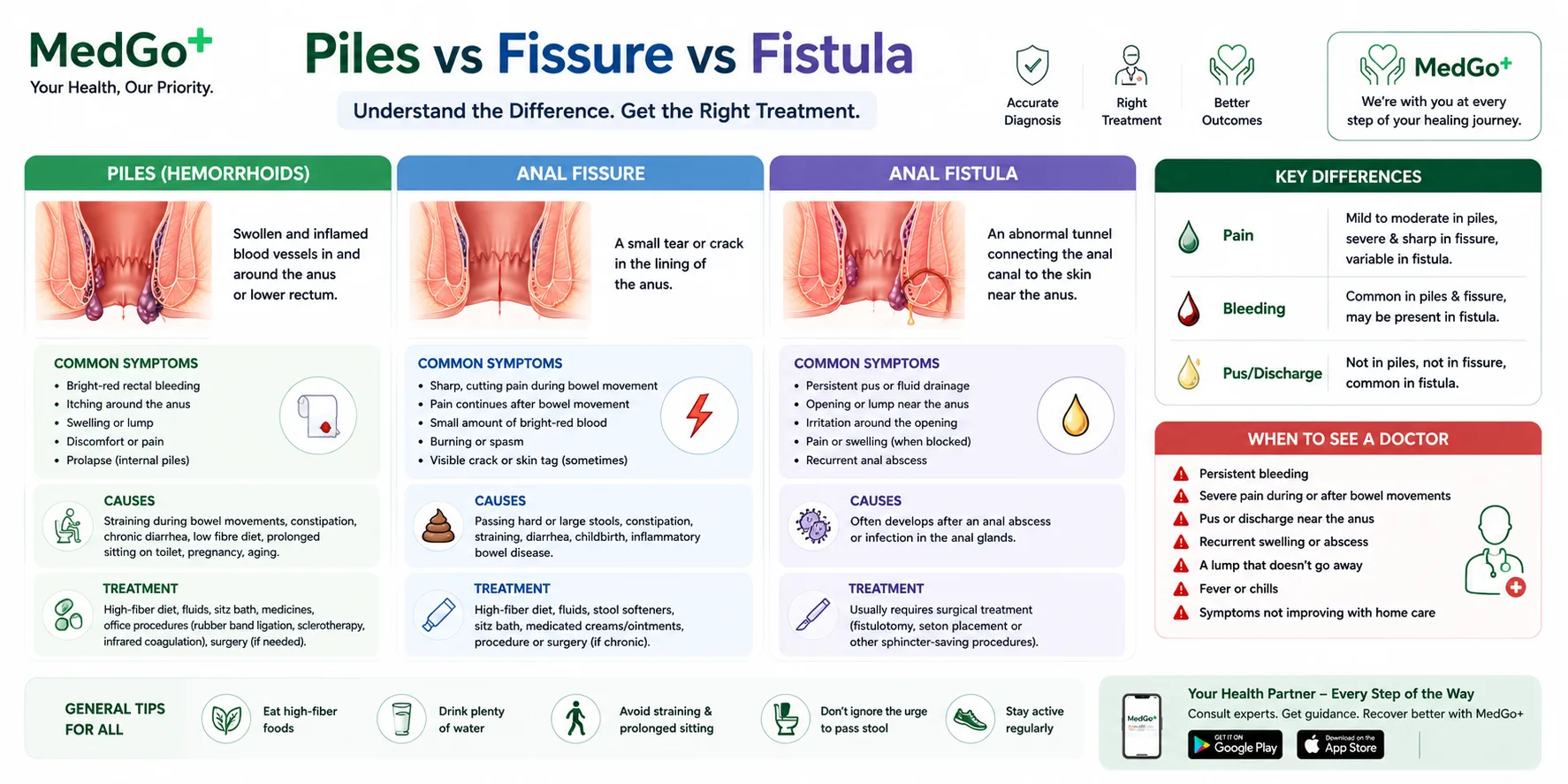
Piles, anal fissure and anal fistula are three different conditions that affect the anal and rectal area. Because they can all cause pain, bleeding, irritation or discomfort, patients sometimes assume they are the same problem.
They are not the same. Piles involve swollen hemorrhoidal tissues, an anal fissure is a tear in the lining of the anus, and an anal fistula is an abnormal tunnel connecting the anal canal to the skin near the anus.
Understanding the differences can help you seek the right medical evaluation. However, symptoms can overlap, so a proper examination is important when the diagnosis is uncertain.
Piles vs Fissure vs Fistula at a Glance
Although these conditions occur in the same general area, their underlying problems are different.
Piles (Hemorrhoids)
Swollen or enlarged hemorrhoidal tissues that may cause bleeding, itching, swelling, discomfort or prolapse.
Anal Fissure
A small tear or crack in the lining of the anus, commonly causing sharp pain during or after bowel movements.
Anal Fistula
An abnormal tunnel between the anal canal and nearby skin, often associated with a previous or ongoing anal abscess or infection.
What Are Piles?
Piles, medically called hemorrhoids, are swollen and inflamed vascular cushions in and around the anus and lower rectum.
They can be internal or external. Internal hemorrhoids develop inside the anal canal, while external hemorrhoids occur under the skin around the anus.
Common Symptoms of Piles
- Bright-red rectal bleeding.
- Itching around the anus.
- Swelling.
- A lump around the anus.
- Discomfort during or after bowel movements.
- Prolapse of internal hemorrhoids.
- Sudden painful swelling when an external hemorrhoid becomes thrombosed.
What Causes Piles?
- Straining during bowel movements.
- Chronic constipation.
- Chronic diarrhea.
- Low dietary fibre.
- Prolonged sitting on the toilet.
- Pregnancy.
- Age-related weakening of supporting tissues.
- Repeated pressure around the anal area.
The goal of treatment is to reduce symptoms and address contributing factors such as constipation and straining.
What Is an Anal Fissure?
An anal fissure is a small tear in the lining of the anus. It can develop when a hard or large stool stretches and injures the anal lining.
Fissures can also occur with repeated diarrhea, childbirth or other situations that place stress on the anal canal.
Typical Symptoms of an Anal Fissure
- Sharp or cutting pain during bowel movements.
- Burning or pain that can continue after a bowel movement.
- Small amounts of bright-red blood.
- Pain associated with passing hard stools.
- A visible crack or skin tag in some cases.
The pain associated with an anal fissure can be much more prominent than the bleeding.
What Causes an Anal Fissure?
- Passing hard or large stools.
- Constipation.
- Repeated straining.
- Persistent diarrhea.
- Childbirth.
- Certain inflammatory bowel conditions.
- Less commonly, other medical conditions affecting the anal area.
What Is an Anal Fistula?
An anal fistula is an abnormal tunnel that forms between the inside of the anal canal and the skin near the anus.
Many anal fistulas develop after an anal abscess. An abscess is a collection of pus caused by infection. After an abscess drains, a persistent abnormal passage can sometimes remain.
Common Symptoms of an Anal Fistula
- A small opening or lump near the anus.
- Repeated pus or fluid drainage.
- Persistent irritation around the opening.
- Pain or swelling, particularly when the fistula becomes blocked.
- Recurrent anal abscesses.
- Skin irritation caused by ongoing discharge.
Piles vs Fissure: Main Differences
Pain
Piles may cause discomfort, itching or pain, particularly with external or thrombosed hemorrhoids. Anal fissures commonly cause sharp pain during and after bowel movements.
Bleeding
Both piles and fissures can cause bright-red bleeding. Bleeding alone cannot reliably distinguish the two conditions.
Lump
Piles may cause a swollen or prolapsing lump. A chronic fissure can sometimes be associated with a small skin tag, while a fistula can produce an opening or swelling near the anus.
Bowel Movement
Constipation and straining can contribute to both piles and fissures, but severe sharp pain during bowel movements is particularly characteristic of an anal fissure.
Piles vs Fistula: Main Differences
Piles are swollen hemorrhoidal tissues, whereas a fistula is an abnormal tunnel between the anal canal and nearby skin.
- Piles commonly cause bleeding, itching, swelling or prolapse.
- Fistulas commonly cause recurrent drainage or pus.
- Piles do not usually cause persistent pus drainage.
- Fistulas may be associated with recurrent abscesses.
- A fistula often requires surgical assessment.
Fissure vs Fistula: Main Differences
Despite the similar names, an anal fissure and anal fistula are completely different conditions.
Fissure
A tear in the anal lining that commonly causes sharp pain during or after bowel movements.
Fistula
An abnormal tunnel connecting the anal canal to the skin, often causing persistent or recurrent drainage.
A fissure does not normally create a tunnel between the anal canal and skin.
Piles, Fissure or Fistula: Which Causes More Pain?
There is no universal pain ranking because symptoms vary between patients.
- Anal fissure commonly causes severe, sharp pain during or after bowel movements.
- Thrombosed external hemorrhoids can cause sudden and significant pain.
- An anal fistula may cause pain when an abscess develops or when the fistula becomes blocked.
- Simple internal hemorrhoids may cause bleeding without significant pain.
Severe pain should not automatically be assumed to be piles. Examination may be needed to determine the cause.
Which Condition Causes Bleeding?
Both piles and anal fissures can cause bright-red rectal bleeding. A fistula may cause blood mixed with drainage, but persistent bleeding should be assessed rather than attributed to a fistula or hemorrhoids without examination.
Rectal bleeding has many possible causes. Persistent, recurrent or unexplained bleeding requires appropriate medical evaluation.
Which Condition Causes Pus or Discharge?
Persistent pus or fluid drainage from an opening near the anus is more suggestive of an anal fistula or an active infection than uncomplicated piles.
A painful lump with fever or pus may indicate an anal abscess and requires prompt medical assessment.
How Are Piles Diagnosed?
A doctor usually diagnoses hemorrhoids using the patient’s symptoms and an examination of the anal area. Depending on the symptoms, a digital rectal examination or anoscopy may be performed.
- Medical history.
- Discussion of bleeding and bowel habits.
- Inspection of the anal area.
- Digital rectal examination when appropriate.
- Anoscopy when required.
- Additional investigations when another cause of bleeding is suspected.
How Is an Anal Fissure Diagnosed?
A doctor can often diagnose an anal fissure by reviewing the symptoms and carefully examining the anal area.
Because fissures can be extremely painful, the examination is performed carefully. Additional testing may be considered when the fissure is unusual, recurrent or associated with symptoms suggesting another condition.
How Is an Anal Fistula Diagnosed?
Diagnosis of an anal fistula usually involves a medical history and physical examination. The doctor looks for an external opening, drainage, swelling or evidence of an abscess.
Some fistulas are complex or difficult to identify on examination. In selected cases, imaging such as MRI or other investigations may be recommended.
Treatment for Piles
Treatment depends on the type and severity of hemorrhoids.
- Fibre and adequate fluids.
- Avoiding straining.
- Healthy toilet habits.
- Treatment of constipation.
- Topical medicines when appropriate.
- Warm sitz baths for symptom relief.
- Rubber band ligation for selected internal hemorrhoids.
- Other office-based procedures.
- Surgery for selected advanced or persistent hemorrhoids.
Treatment for Anal Fissure
Many acute anal fissures can improve with measures that keep stools soft and reduce trauma to the anal lining.
- Fibre-rich diet.
- Adequate fluids.
- Treatment of constipation.
- Stool-softening measures when appropriate.
- Warm sitz baths.
- Prescription medicines that relax the anal sphincter when indicated.
Chronic fissures that do not respond to medical treatment may require a procedure or surgery. Treatment should be individualized by a qualified clinician.
Treatment for Anal Fistula
An anal fistula usually does not heal permanently with diet, creams or home remedies alone. Many fistulas require surgical assessment and treatment.
- Assessment by a colorectal or appropriately trained surgeon.
- Drainage of an abscess when present.
- Fistulotomy for suitable fistulas.
- Seton placement for selected fistulas.
- Other sphincter-preserving procedures for complex fistulas.
The treatment depends heavily on the fistula’s path and its relationship to the anal sphincter muscles.
Can Piles, Fissure or Fistula Heal Without Surgery?
Piles
Many mild hemorrhoids improve with fibre, hydration, bowel-habit changes and appropriate medical treatment. Some symptomatic hemorrhoids may require office procedures.
Fissure
Many acute fissures can heal without surgery when constipation and stool trauma are appropriately managed.
Fistula
A persistent anal fistula usually requires medical and often surgical treatment rather than relying on home care alone.
Can Piles Turn Into a Fistula?
Piles do not normally turn into an anal fistula. They are different conditions with different underlying mechanisms.
If someone diagnosed with piles develops persistent pus, recurrent swelling or an opening that repeatedly drains near the anus, another condition such as a fistula should be considered and evaluated.
Can a Fissure Turn Into a Fistula?
A typical anal fissure is a tear in the anal lining and is different from a fistula. A chronic fissure can develop associated skin changes, but it should not simply be assumed to have become a fistula.
Persistent drainage, recurrent abscesses or an external opening require medical assessment to determine whether a fistula or another condition is present.
Piles vs Fissure vs Fistula: Simple Symptom Guide
- Bright-red bleeding without severe pain → hemorrhoids are one possible cause.
- Sharp pain during and after bowel movements → anal fissure is a possibility.
- Persistent pus or fluid from an opening near the anus → anal fistula is a possibility.
- Sudden painful lump → thrombosed external hemorrhoid or abscess should be considered.
- Fever with painful anal swelling → possible abscess and requires prompt assessment.
- Repeated drainage from the same opening → possible fistula.
These patterns are useful for understanding symptoms but cannot replace a medical diagnosis.
When Is an Anal Abscess an Emergency?
An anal abscess is a collection of pus caused by infection and can cause severe pain, swelling and sometimes fever.
- Severe or rapidly increasing anal pain.
- Painful swelling or lump.
- Fever or chills.
- Pus or foul-smelling drainage.
- Feeling increasingly unwell.
An abscess may require prompt drainage. Do not attempt to squeeze or drain a suspected abscess yourself.
When Should You See a Doctor?
You should seek medical evaluation if you have persistent anal symptoms, especially when the diagnosis is uncertain.
- Repeated rectal bleeding.
- Severe anal pain.
- Persistent pain after bowel movements.
- A lump that does not improve.
- Pus or persistent drainage.
- A recurring opening near the anus.
- Fever or chills.
- Repeated anal swelling.
- Symptoms that do not improve with appropriate home treatment.
- Unexplained changes in bowel habits.
Warning Signs That Need Urgent Medical Attention
- Heavy or continuous rectal bleeding.
- Severe uncontrolled anal pain.
- Fever with painful anal swelling.
- Rapidly increasing swelling.
- Pus with fever or worsening pain.
- Dizziness or fainting associated with bleeding.
- Severe abdominal pain.
- Rapidly worsening symptoms.
These symptoms may indicate a complication or another condition that requires prompt treatment.
How to Reduce the Risk of Piles and Fissure
- Eat adequate fibre.
- Drink sufficient fluids unless medically restricted.
- Avoid excessive straining.
- Treat constipation early.
- Do not sit on the toilet for long periods.
- Stay physically active.
- Do not ignore the urge to have a bowel movement.
Can Diet Prevent Fistula?
A healthy diet supports overall digestive health, but diet alone cannot reliably prevent or cure an anal fistula.
Because many fistulas are associated with previous anal abscesses or other underlying conditions, persistent drainage or recurrent swelling requires medical evaluation.
Questions to Ask Your Doctor
- Do I have piles, an anal fissure or a fistula?
- What is causing my bleeding or pain?
- Do I need an examination or anoscopy?
- Could this be an anal abscess?
- Can my condition be treated without surgery?
- What treatment do you recommend and why?
- Do I need imaging such as an MRI?
- If surgery is required, what procedure is appropriate?
- What are the risks of delaying treatment?
- When should I return for follow-up?
How MedGoPlus Can Help
Piles, fissure and fistula can look similar from a patient’s perspective, but their treatments are different. MedGoPlus can help patients connect with qualified healthcare professionals through available consultation services for assessment, treatment guidance and follow-up.
If you are experiencing persistent bleeding, severe anal pain, recurrent swelling or drainage near the anus, speaking with a qualified doctor can help establish the correct diagnosis.
The Bottom Line
Piles are swollen hemorrhoidal tissues, an anal fissure is a tear in the anal lining, and an anal fistula is an abnormal tunnel between the anal canal and nearby skin.
Pain, bleeding and anal discomfort can occur with more than one condition, so symptoms alone are not always enough to determine the diagnosis. Persistent or unusual symptoms should be assessed by a healthcare professional.
Medical Disclaimer
This article is intended for general health education and does not replace a medical examination, diagnosis or individualized treatment plan. If you have rectal bleeding, severe anal pain, fever, swelling, pus or persistent symptoms, consult a qualified healthcare professional.
Take Control of Your Health with MedGoPlus
Book doctor consultations, manage your health needs, and access convenient healthcare services anytime, anywhere with the MedGoPlus App.
Scan to download
Download the MedGoPlus App