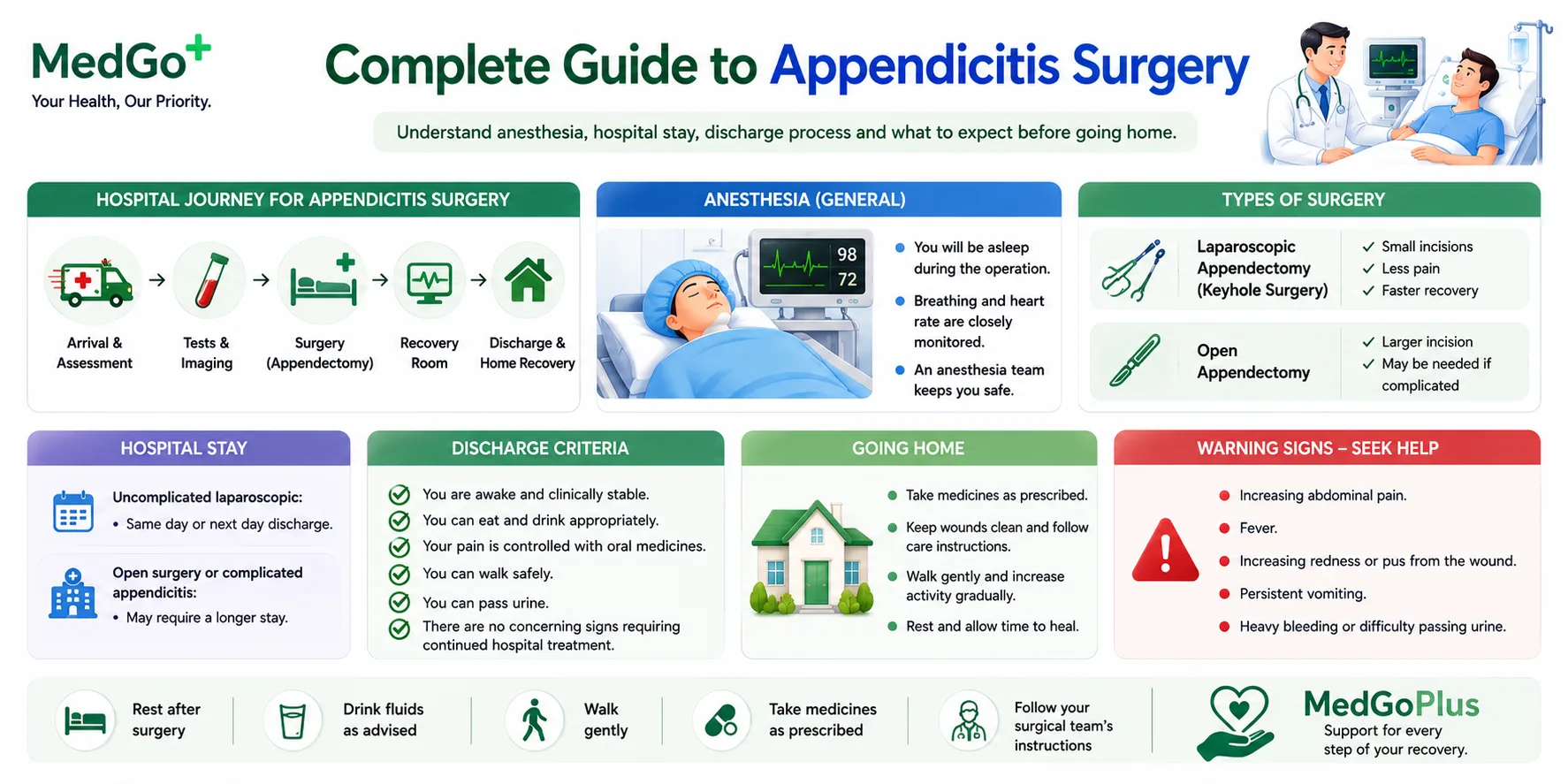
When appendicitis requires surgery, patients and families often have many practical questions: What anesthesia is used? How long does the operation take? Is ICU required? How many days will I stay in the hospital? When can I eat? When can I walk? And what needs to happen before I can safely go home?
Appendix removal is called an appendectomy or appendicectomy. It is usually performed under general anesthesia. The operation may be performed using laparoscopic keyhole surgery or, when necessary, through an open incision.
The hospital stay depends mainly on whether the appendicitis is uncomplicated or complicated by perforation, abscess or widespread infection, as well as the patient’s overall health and recovery.
Appendicitis Surgery: The Complete Hospital Journey
- Emergency or surgical assessment.
- Blood tests and imaging when required.
- Fasting and preoperative preparation.
- Intravenous fluids and medicines.
- Antibiotics when indicated.
- Anesthesia assessment.
- General anesthesia.
- Laparoscopic or open appendectomy.
- Recovery-room monitoring.
- Pain and nausea management.
- Gradual return to drinking and eating.
- Walking and mobility assessment.
- Wound assessment.
- Discharge planning.
- Home recovery and follow-up instructions.
What Happens When You Arrive at the Hospital?
If appendicitis is suspected, the medical team will assess your symptoms, perform an abdominal examination and order tests when necessary.
- Vital signs will be checked.
- Your abdominal pain and symptoms will be reviewed.
- Blood tests may be performed.
- Urine testing may be performed.
- Imaging may be arranged.
- An intravenous line may be inserted.
- Pain and nausea medicines may be given.
- Antibiotics may be started when indicated.
If surgery is recommended, a surgeon will explain the procedure, expected benefits, possible risks and alternatives before obtaining informed consent.
Why Are Antibiotics Given Before Appendix Surgery?
Appendicitis involves inflammation and infection, so antibiotics are commonly used as part of hospital treatment. They may be given before surgery to help control bacterial infection and are particularly important when perforation or other complications are present.
The exact antibiotic and duration depend on the patient, local protocols and whether the appendix has ruptured or there is an abscess or widespread infection.
Why Do I Need to Fast Before Appendix Surgery?
Because appendectomy is generally performed under general anesthesia, the anesthesiology team needs your stomach to be appropriately empty before anesthesia.
Your surgical team will tell you exactly when to stop eating and drinking. Because appendicitis is often an emergency, the fasting plan may need to be adapted to the clinical situation.
Do not eat or drink against the instructions given by your medical team.
What Does the Anesthesiologist Do?
Before surgery, an anesthesiologist or anesthesia team assesses your overall health and determines the safest anesthesia plan.
- Review your medical history.
- Review allergies and current medicines.
- Ask about previous anesthesia problems.
- Assess your heart and lungs.
- Review blood-test and other relevant results.
- Discuss the general anesthetic.
- Plan pain and nausea control.
- Explain important anesthesia-related risks.
What Anesthesia Is Used for Appendix Surgery?
Appendectomy is generally performed under general anesthesia. This means you are unconscious during the operation and do not feel the surgical procedure.
The anesthesia team continuously monitors important functions such as breathing, oxygen levels, blood pressure and heart rate during surgery.
What Happens When General Anesthesia Starts?
You will usually receive medicines through an intravenous line and may breathe oxygen through a mask. Once you are fully asleep, the anesthesia team maintains anesthesia throughout the operation and closely monitors you.
A breathing tube is commonly placed after you are asleep to help protect and manage your airway during general anesthesia.
After surgery, the anesthesia medicines are stopped and you are transferred to the recovery area while you wake up.
How Long Does Appendix Surgery Take?
A straightforward appendectomy often takes around one hour, although the actual operating time varies.
The total time you spend in the operating department is longer because it includes anesthesia preparation, positioning, surgery, waking from anesthesia and transfer to the recovery area.
Complicated appendicitis, including a ruptured appendix or extensive infection, may require a longer and more complex operation.
Laparoscopic Appendectomy: Keyhole Surgery
Laparoscopic appendectomy is the commonly used approach when it is suitable for the patient.
- Several small abdominal incisions are made.
- The abdomen is accessed using specialized surgical instruments.
- A laparoscope with a camera allows the surgeon to see inside the abdomen.
- The appendix is identified.
- The appendix is separated from surrounding tissues.
- The appendix is removed.
- The abdomen is checked for infection or complications.
- The small wounds are closed using appropriate methods.
Laparoscopic surgery generally results in smaller incisions and may allow faster recovery than open surgery.
Open Appendectomy
Open appendectomy uses a larger abdominal incision to access and remove the appendix.
Open surgery may be required when the appendix has ruptured, there is extensive infection, the anatomy is difficult or the surgeon determines that open access is safer.
The final surgical approach may sometimes be changed during the operation if this is necessary for patient safety.
What If the Appendix Has Already Burst?
A ruptured or perforated appendix can release infected material into the abdomen. This can cause peritonitis or an abscess and usually makes treatment more complex.
- Intravenous antibiotics.
- Surgical removal of the appendix when appropriate.
- Cleaning of infected material during surgery when required.
- Drainage of an abscess when necessary.
- Longer hospital monitoring.
- Additional antibiotics after surgery when indicated.
A ruptured appendix does not mean every patient will require ICU care. The need for intensive care depends on the patient’s overall condition and severity of infection.
What Happens Immediately After Appendix Surgery?
After surgery, you will be transferred to a recovery area. Nurses and the anesthesia team monitor you while you wake from general anesthesia.
- Blood pressure is monitored.
- Heart rate is monitored.
- Oxygen levels are monitored.
- Pain is assessed.
- Nausea is treated if necessary.
- Your breathing is observed.
- Your surgical wounds are checked.
Will I Wake Up in the ICU?
Usually, no. After an uncomplicated appendectomy, most patients wake up in a postoperative recovery area rather than an ICU.
An ICU may be required if a patient is critically unwell, has severe infection, significant organ problems or requires intensive monitoring or support.
ICU admission is therefore determined by the patient’s condition rather than simply by the fact that appendix surgery was performed.
Do You Need ICU After Appendix Surgery?
For an uncomplicated appendectomy, ICU care is not routinely required.
Most patients recover in the postoperative recovery area and then move to a regular ward or day-case area before discharge.
Patients with severe sepsis, major complications, significant medical conditions or other reasons for intensive monitoring may require ICU care.
What Happens in the Recovery Room?
The recovery room is where you are monitored as the effects of anesthesia wear off.
- You gradually become more awake.
- Your breathing and oxygen level are monitored.
- Pain relief is provided.
- Nausea medicines may be given.
- Your blood pressure and heart rate are monitored.
- The surgical wounds are checked.
- The team determines when you are ready to return to the ward or day-case area.
What Will I Feel After General Anesthesia?
It is common to feel sleepy or tired after general anesthesia. Some people experience nausea, dizziness or a sore throat caused by the breathing tube used during anesthesia.
These effects usually improve as the anesthetic medicines wear off.
Tell your healthcare team if you have significant pain, persistent nausea, difficulty breathing or any other concerning symptoms.
When Can I Drink After Appendix Surgery?
After surgery, you can generally begin drinking once you are sufficiently awake and your medical team considers it appropriate.
Start according to the instructions provided by your healthcare team. If you tolerate fluids without significant nausea or vomiting, your diet can usually be advanced as appropriate.
When Can I Eat After Appendix Surgery?
After an uncomplicated appendectomy, many patients can begin eating once they are awake and feel able to eat.
There is generally no requirement for a special long-term diet simply because the appendix has been removed.
If you have significant nausea, vomiting, bowel complications or complicated appendicitis, your diet may be advanced more slowly according to your clinical condition.
When Can I Get Out of Bed?
You can generally begin getting out of bed and walking once you are sufficiently awake and your healthcare team considers it safe.
- Start with assistance if you feel dizzy or weak.
- Take short walks.
- Increase movement gradually.
- Avoid prolonged bed rest unless medically necessary.
- Tell staff if you feel faint or unusually weak.
How Long Will I Stay in the Hospital?
Hospital stay varies significantly depending on the severity of appendicitis and the type of operation.
Uncomplicated Laparoscopic Appendectomy
Some patients can go home on the same day, while others stay overnight. The exact practice varies between hospitals and depends on the patient’s recovery.
Open Appendectomy
Open surgery may require a longer hospital stay, particularly when it is performed because of complicated appendicitis.
Ruptured or Complicated Appendicitis
A ruptured appendix, abscess, peritonitis or significant infection may require several days of inpatient treatment.
Can I Go Home the Same Day?
Yes, some patients with uncomplicated appendicitis can be discharged on the same day after laparoscopic appendectomy if they recover well and meet the hospital’s discharge criteria.
Other patients may stay overnight for observation, pain control or because of their individual medical circumstances.
Same-day discharge should never be viewed as a fixed rule. The surgical team decides when it is safe for the individual patient to leave.
What Are the Discharge Criteria After Appendix Surgery?
Before discharge, your healthcare team will generally want to see that you are recovering safely from anesthesia and surgery.
- You are awake and clinically stable.
- You can drink fluids without significant vomiting.
- You can eat when appropriate.
- Your pain is controlled with medicines suitable for home.
- You can get out of bed and walk safely.
- You can pass urine.
- There is no concerning bleeding.
- Your wounds have been checked.
- There are no signs requiring continued inpatient treatment.
- You understand your medicines and wound-care instructions.
Hospitals may use slightly different discharge criteria depending on their protocols and the patient’s condition.
Do I Need Someone to Take Me Home?
If you are discharged on the same day after general anesthesia, you will generally need a responsible adult to take you home and stay with you according to the hospital’s instructions.
You should not drive yourself home immediately after general anesthesia.
What Medicines Will I Get at Discharge?
Your discharge medicines depend on your surgery, pain level and whether the appendix was complicated by infection.
- Pain-relief medicines.
- Antibiotics when indicated.
- Medicines for nausea when necessary.
- Bowel medicines when appropriate.
- Other medicines related to your existing medical conditions.
Take medicines exactly as prescribed. If antibiotics are prescribed, complete the course unless your doctor specifically tells you to stop.
Do I Need Antibiotics After Appendix Surgery?
Not every patient needs antibiotics for a prolonged period after an uncomplicated appendectomy.
Patients with perforation, abscess, peritonitis or other significant infection may require antibiotics after surgery. The duration depends on the clinical situation and your surgical team’s treatment plan.
What Will My Appendix Surgery Wounds Look Like?
After laparoscopic surgery, you will usually have several small abdominal wounds. These may be closed with dissolvable stitches, skin glue or other appropriate methods.
Open surgery produces a larger incision.
- Keep the wounds clean according to your instructions.
- Follow dressing instructions.
- Watch for increasing redness.
- Watch for increasing swelling.
- Watch for pus or unusual drainage.
- Report worsening wound pain or fever.
Is Pain Normal After Appendix Surgery?
Some abdominal and wound pain is expected after appendectomy. Pain should generally become easier to manage as recovery progresses.
After laparoscopic surgery, some patients also experience temporary shoulder discomfort caused by the gas used to inflate the abdomen during the procedure.
- Take prescribed pain medicines.
- Move gently as tolerated.
- Avoid activities that cause significant pain.
- Contact your healthcare team if pain becomes severe or progressively worse.
Can I Shower After Appendix Surgery?
Many patients can shower after surgery, but the exact timing depends on the wound closure and your surgeon’s instructions.
Do not soak the wounds in a bath or swimming pool until your surgical team confirms that it is safe.
Follow the wound-care instructions provided at discharge.
When Can I Drive After Appendix Surgery?
Do not drive while you are still affected by general anesthesia or medicines that impair alertness.
You should also be physically able to sit comfortably, control the vehicle and perform an emergency stop without significant pain.
The exact timing varies, so follow your surgeon’s advice and any relevant insurance requirements.
When Can I Return to Work?
Many people need approximately one to two weeks away from work after appendectomy, although some people with desk-based jobs may return sooner.
People with physically demanding jobs or those who had open or complicated surgery may need longer.
Your return-to-work date should be based on your recovery and the physical demands of your job.
When Can I Exercise After Appendix Surgery?
Gentle walking is generally encouraged early in recovery. Strenuous exercise and heavy lifting should be delayed until your surgeon says it is safe.
After laparoscopic surgery, physical activity restrictions may be shorter than after open surgery, but the exact timing depends on your operation and recovery.
What Should I Eat After Appendix Surgery?
After an uncomplicated appendectomy, most patients can gradually return to their usual diet as tolerated.
- Start with foods you tolerate comfortably.
- Drink adequate fluids.
- Include protein-rich foods.
- Eat fruits and vegetables as tolerated.
- Increase fibre if constipation develops.
- Avoid foods that clearly worsen nausea or stomach discomfort.
There is generally no permanent special diet required after appendix removal.
What Should I Expect During the First Night at Home?
You may feel tired, sleepy or mildly uncomfortable during the first night after surgery.
- Rest and avoid strenuous activity.
- Take prescribed medicines on schedule.
- Drink fluids as advised.
- Follow your wound-care instructions.
- Have someone available to help you if required.
- Monitor for fever, worsening pain or wound problems.
What Are the Warning Signs After Appendix Surgery?
Contact your healthcare team if your recovery is not progressing as expected.
- Increasing abdominal pain.
- Persistent or high fever.
- Increasing redness around the wound.
- Increasing swelling around the wound.
- Pus or foul-smelling wound drainage.
- Persistent vomiting.
- Increasing abdominal swelling.
- Heavy bleeding.
- Difficulty passing urine.
- Severe weakness or dizziness.
- Shortness of breath.
- Pain or swelling in the calf.
When Should I Go Back to the Hospital?
Seek urgent medical attention if you develop severe or rapidly worsening abdominal pain, significant bleeding, difficulty breathing, fainting, severe weakness or other symptoms suggesting a serious complication.
A fever with worsening abdominal pain, increasing wound redness, pus or persistent vomiting should also prompt medical review.
What Are the Possible Complications After Appendectomy?
Appendectomy is generally safe, but complications can occur.
- Surgical-site infection.
- Abdominal abscess.
- Bleeding.
- Bowel obstruction.
- Temporary bowel inactivity.
- Internal scar tissue or adhesions.
- Rare injury to nearby structures.
- Blood clots.
The risk of complications may be higher when appendicitis has ruptured or caused widespread infection.
Same-Day Discharge vs Overnight Stay
Same-Day Discharge May Be Possible When
- The appendicitis was uncomplicated.
- The operation was completed without significant complications.
- You have recovered appropriately from anesthesia.
- You can drink and eat as appropriate.
- Your pain is controlled with oral medicines.
- You can walk safely.
- You can pass urine.
- There are no concerning signs requiring admission.
A Longer Stay May Be Needed When
- The appendix has ruptured.
- There is an abdominal abscess.
- There is peritonitis.
- You require intravenous antibiotics.
- Pain or nausea is difficult to control.
- You cannot eat or drink adequately.
- You have another medical condition requiring monitoring.
- There are postoperative complications.
How Many Days Will I Stay If My Appendix Burst?
There is no fixed number of hospital days for a ruptured appendix. Some patients require several days of treatment because they need intravenous antibiotics, drainage, additional monitoring or treatment for peritonitis.
The discharge date depends on infection control, pain, ability to eat and drink, mobility, bowel and bladder function and overall clinical stability.
What Happens Before I Leave the Hospital?
- Your surgical wounds are checked.
- Your pain is assessed.
- Your ability to move around is assessed.
- Your ability to eat and drink is reviewed.
- Your medications are explained.
- Antibiotics are prescribed when required.
- Wound-care instructions are provided.
- Activity restrictions are explained.
- Warning signs are discussed.
- Follow-up instructions are provided when required.
- A responsible adult is arranged to take you home when needed.
What Questions Should I Ask Before Discharge?
- What type of appendectomy did I have?
- Was my appendix ruptured?
- Was there an abscess or peritonitis?
- Do I need antibiotics at home?
- Which pain medicines should I take?
- How should I care for my wounds?
- When can I shower?
- When can I drive?
- When can I return to work?
- When can I exercise?
- How much lifting is allowed?
- When should I attend follow-up?
- Who should I contact if I develop a problem?
- Which symptoms require emergency care?
Can You Live Normally Without an Appendix?
Yes. The appendix is not essential for normal everyday life, and most people can return to their usual diet, exercise and lifestyle after recovery from appendectomy.
Your surgeon may temporarily restrict certain activities while the abdominal wounds heal.
How MedGoPlus Can Help
Appendicitis can be frightening, especially when surgery is recommended urgently. Understanding anesthesia, the operation, hospital stay and discharge process can help patients and families feel more prepared.
MedGoPlus can help patients connect with qualified healthcare professionals through available consultation services for medical guidance, postoperative questions and follow-up care.
If you have severe or worsening abdominal pain and appendicitis is suspected, do not delay emergency medical assessment while trying to arrange an online consultation.
The Bottom Line
Appendix surgery is usually performed under general anesthesia and can often be completed using laparoscopic keyhole surgery. An uncomplicated operation may allow discharge the same day or the following day, while open surgery or complicated appendicitis may require a longer hospital stay.
ICU care is not routinely required after an uncomplicated appendectomy. The need for intensive care depends on the patient’s overall condition, severity of infection and any complications.
Before discharge, the healthcare team will make sure that you are clinically stable, your pain is manageable, you can move safely and eat or drink appropriately, and that there are no concerns requiring continued hospital treatment.
Medical Disclaimer
This article is intended for general health education and does not replace an examination, diagnosis or individualized medical advice. Appendicitis can become a medical emergency. If you have severe or worsening abdominal pain, fever, repeated vomiting, significant abdominal tenderness or other concerning symptoms, seek urgent medical care.
Take Control of Your Health with MedGoPlus
Book doctor consultations, manage your health needs, and access convenient healthcare services anytime, anywhere with the MedGoPlus App.
Scan to download
Download the MedGoPlus App