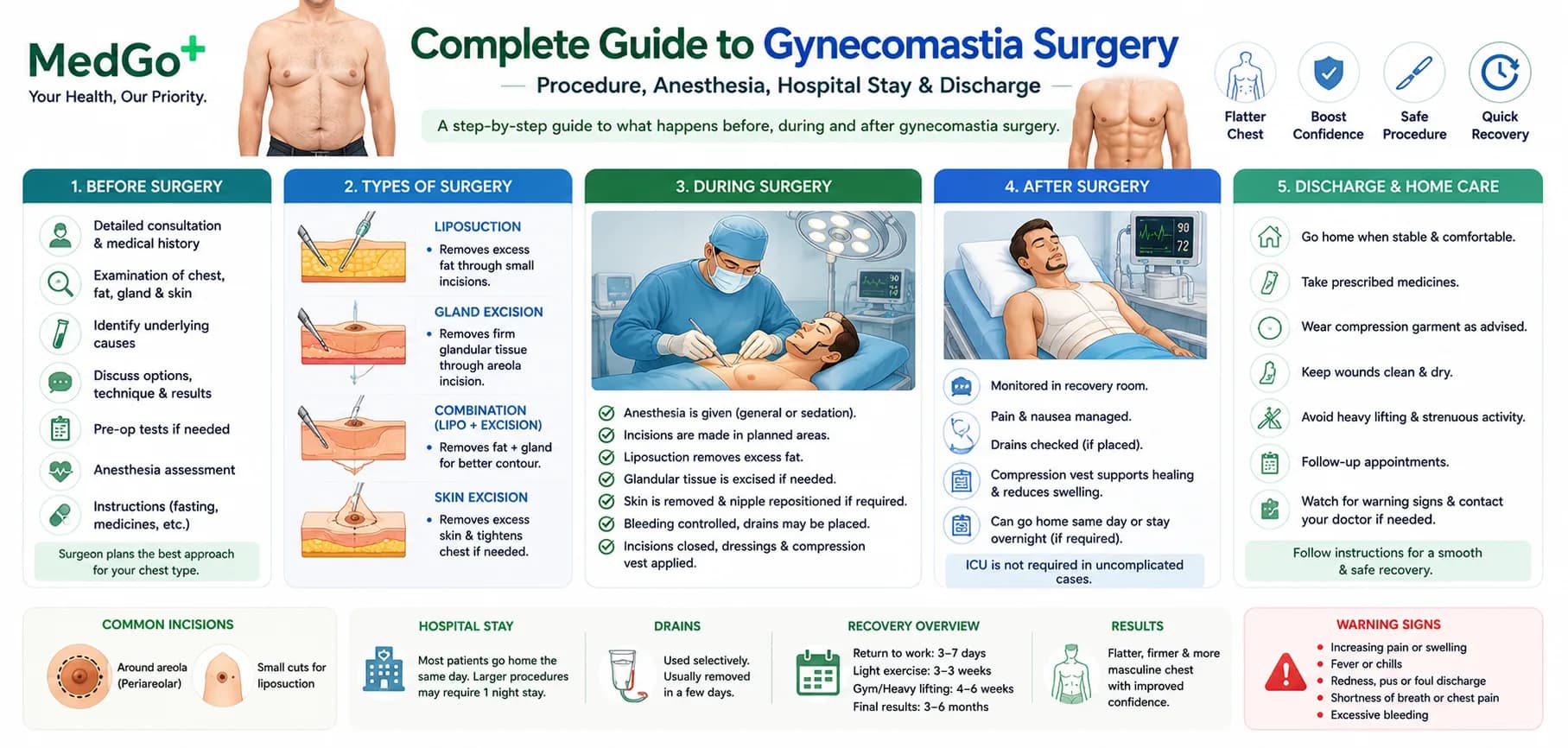
Gynecomastia surgery, also called male breast reduction surgery, is performed to reduce excess breast tissue and create a flatter, more natural male chest contour. The enlargement may be caused by glandular breast tissue, excess fat, loose skin, or a combination of these.
From a surgeon’s perspective, the most important part of gynecomastia treatment is not simply removing tissue. The goal is to understand why the chest is enlarged, determine what type of tissue is responsible, assess the skin and nipple position, and then choose the safest technique that produces a balanced chest contour.
Depending on the patient, surgery may involve liposuction, direct removal of glandular tissue, removal of excess skin, or a combination of techniques.
Gynecomastia Surgery: The Complete Patient Journey
- Initial consultation and medical history.
- Physical examination of the chest.
- Assessment of fat, glandular tissue and skin.
- Evaluation for possible underlying medical or medication-related causes.
- Discussion of treatment options and expected results.
- Preoperative investigations when indicated.
- Anesthesia assessment.
- Surgical marking before the procedure.
- Liposuction, gland excision, skin excision or a combination.
- Wound closure and dressing.
- Compression garment when recommended.
- Recovery-room monitoring.
- Pain and nausea management.
- Discharge when clinically appropriate.
- Follow-up and gradual return to normal activities.
What Exactly Is Gynecomastia?
Gynecomastia is enlargement of male breast tissue. It can occur on one side or both sides and may involve glandular tissue, fatty tissue, loose skin or a combination.
Common contributing factors include hormonal changes, certain medicines, obesity, anabolic steroid use and other medical conditions. In some patients, no specific cause is identified.
True gynecomastia should be distinguished from pseudogynecomastia, where the chest enlargement is predominantly caused by excess fat rather than increased glandular breast tissue.
Is Gynecomastia Always Treated With Surgery?
No. Surgery is not automatically required for every person with enlarged male breasts.
The first step is to determine the cause and whether the enlargement is likely to improve with treatment of an underlying problem, medication review, weight management or observation.
Surgery becomes an option when the enlargement persists, causes significant physical or psychological distress, or does not adequately respond to appropriate non-surgical management.
The decision should be individualized after examination by an appropriately qualified surgeon.
What Does the Surgeon Check Before Surgery?
A proper consultation is essential because not every enlarged male chest has the same cause or requires the same operation.
- How long the enlargement has been present.
- Whether one or both sides are affected.
- Whether the tissue is predominantly fat or glandular tissue.
- Whether there is tenderness or pain.
- The amount of loose or excess skin.
- Nipple and areola position.
- Chest wall shape and muscle definition.
- Previous chest surgery or trauma.
- Current medicines and supplements.
- Use of anabolic steroids or other substances.
- Relevant medical conditions.
- Smoking or nicotine use.
- Previous anesthesia or surgical problems.
Why Is It Important to Find the Cause First?
Removing the excess tissue can improve the chest contour, but surgery does not necessarily eliminate the underlying reason why gynecomastia developed.
If a reversible cause is present and continues after surgery, recurrent or persistent enlargement may occur.
For this reason, the surgeon should review relevant medicines, supplements, hormone-related conditions and other medical factors before proceeding.
Can Gynecomastia Be Cancer?
Most gynecomastia is benign. However, a new or unusual breast lump should not automatically be assumed to be gynecomastia.
A hard or fixed lump, particularly when it is one-sided or located away from the nipple, or symptoms such as nipple discharge, skin changes or enlarged lymph nodes, require appropriate medical evaluation.
If the clinical examination raises concern, the doctor may recommend imaging or other investigations before cosmetic surgery is considered.
Who May Be a Candidate for Gynecomastia Surgery?
- Patients with persistent gynecomastia that has stabilized.
- Patients whose chest enlargement causes significant physical or emotional distress.
- Patients who are medically fit for surgery.
- Patients with realistic expectations.
- Patients who understand the possibility of scars and contour changes.
- Patients whose underlying causes have been appropriately assessed.
- Patients who are prepared to follow postoperative instructions.
A surgeon should determine candidacy individually rather than using age or chest size alone.
How Is Gynecomastia Surgery Planned?
Before surgery, the surgeon examines the chest from the front, side and oblique angles. The chest may be marked while you are standing so that asymmetry and areas requiring contouring can be identified.
The surgeon considers the amount of glandular tissue, fat, skin excess and nipple position before deciding how much tissue should be removed.
The goal is not simply to remove as much tissue as possible. Excessive removal directly beneath the nipple can create a hollow or crater-like appearance. Good gynecomastia surgery is therefore a contouring procedure as much as a tissue-removal procedure.
What Are the Main Types of Gynecomastia Surgery?
1. Liposuction
Liposuction is useful when a significant portion of the chest enlargement is caused by excess fatty tissue. A thin cannula is inserted through small incisions and fat is removed while contouring the chest.
2. Glandular Tissue Excision
Firm glandular tissue located beneath the nipple may require direct surgical removal. This is commonly performed through an incision around the edge of the areola.
3. Combination Surgery
Many patients have both glandular tissue and excess fat. In these cases, liposuction may be combined with direct gland excision to create a smoother contour.
4. Skin Excision
Patients with significant loose skin, particularly after major weight loss or with more advanced enlargement, may require skin removal in addition to tissue reduction.
Why Is Liposuction Alone Sometimes Not Enough?
Liposuction removes fat, but it does not directly remove firm glandular breast tissue.
If a firm disc or mass of glandular tissue remains beneath the nipple, removing only the surrounding fat may leave a persistent bulge.
This is why many patients require a combination of liposuction and gland excision rather than liposuction alone.
What If I Have Loose Skin?
When the skin has significant excess or has lost its ability to contract adequately, removing the underlying tissue alone may leave sagging.
In these situations, the surgeon may need to remove some skin and reposition the nipple-areola complex to create a flatter and more proportional chest.
More extensive skin removal produces longer scars, so the surgeon balances the amount of scarring against the amount of correction required.
What Anesthesia Is Used?
Gynecomastia surgery may be performed using general anesthesia or, in selected patients and depending on the procedure, intravenous sedation with local anesthesia.
The safest choice depends on the extent of surgery, the patient’s medical history, the surgical facility and the anesthesiologist’s assessment.
For larger procedures involving significant liposuction, gland excision or skin removal, general anesthesia is commonly selected.
What Happens Before Anesthesia?
- Your identity and procedure are confirmed.
- Your medical history is reviewed.
- Allergies and current medicines are checked.
- Previous anesthesia problems are discussed.
- Vital signs are measured.
- Required investigations are reviewed.
- The anesthesia plan is discussed.
- The chest is marked by the surgeon.
- Consent and surgical-site checks are completed.
What Happens During Gynecomastia Surgery?
Once anesthesia is established, the surgeon prepares and marks the chest and begins the planned procedure.
- Small access incisions are made for liposuction when required.
- Excess fatty tissue is removed and the chest is contoured.
- Glandular tissue is removed through an appropriate incision when necessary.
- Excess skin is removed when required.
- The nipple and areola are repositioned when necessary for larger corrections.
- The surgeon checks symmetry and contour from multiple angles.
- Bleeding is controlled carefully.
- Drains may be placed when indicated.
- Incisions are closed.
- Dressings and compression garments are applied according to the surgical plan.
How Does the Surgeon Create a Natural Male Chest?
The surgeon does not simply flatten the chest. The objective is to create a natural transition from the chest muscle to the surrounding tissues.
Fat is often contoured around the central glandular area so that the chest does not look artificially hollow after tissue removal.
The amount of tissue removed is therefore determined by the patient’s anatomy, skin quality, chest wall shape and desired contour rather than by a fixed number.
How Long Does Gynecomastia Surgery Take?
The operating time varies according to the amount of tissue, the surgical technique and whether liposuction, gland excision or skin removal is required.
A straightforward procedure may take around two to three hours, while more extensive surgery can take longer.
The total time in the operating department is longer than the actual surgical time because anesthesia preparation, positioning, recovery and transfer are also involved.
Are Drains Needed After Gynecomastia Surgery?
Not every patient requires a drain. Some surgeons use drains selectively, while others may avoid them in appropriate cases.
A drain is a small tube that allows blood or other fluid to leave the surgical area and can reduce the risk of a significant fluid collection in selected patients.
Whether drains are used depends on the amount of tissue removed, the extent of dissection, bleeding risk and the surgeon’s technique.
What If I Have a Drain?
- The drain exits through a small separate opening in the skin.
- Fluid collects in a small reservoir.
- You may be asked to record the amount and appearance of drainage.
- The drain should be kept secure.
- The surgical team will tell you when it should be removed.
- Do not pull or manipulate the drain yourself.
Drain removal is usually a simple procedure performed by a healthcare professional.
Why Is a Compression Garment Used?
A compression vest or garment is commonly recommended after gynecomastia surgery to support the healing tissues and help control swelling.
It can also help the skin adapt to the new chest contour and may make movement more comfortable during the early recovery period.
The duration and amount of compression vary between surgeons and procedures. Follow the specific instructions provided by your surgical team.
What Happens Immediately After Surgery?
After the operation, you are transferred to a postoperative recovery area. The anesthesia and nursing teams monitor you while you wake up.
- Blood pressure is monitored.
- Heart rate is monitored.
- Oxygen levels are monitored.
- Pain is assessed.
- Nausea is treated when necessary.
- Dressings are checked.
- Drains are checked if present.
- The chest is assessed for significant swelling or bleeding.
Do I Need ICU After Gynecomastia Surgery?
Routine ICU admission is not normally required after an uncomplicated gynecomastia operation.
Most patients recover in a postoperative recovery area and then either go home the same day or remain in a regular surgical area for observation, depending on the procedure and hospital protocol.
ICU-level care would generally only be considered if a patient has a significant medical problem or an unexpected complication requiring intensive monitoring or support.
Is Gynecomastia Surgery Usually an Inpatient Operation?
Many gynecomastia procedures are performed as outpatient or day-case surgery, meaning the patient can return home after adequate recovery from anesthesia and appropriate postoperative assessment.
Some patients may stay overnight because of the extent of surgery, medical conditions, pain control, distance from the hospital, surgeon preference or local hospital protocols.
The decision should be based on safety rather than a predetermined number of hospital days.
When Can I Go Home After Gynecomastia Surgery?
For an uncomplicated outpatient procedure, discharge is often possible once the patient has recovered adequately from anesthesia and meets the surgical team’s discharge criteria.
- You are awake and clinically stable.
- Pain is adequately controlled.
- There is no concerning bleeding.
- You can drink fluids as appropriate.
- Nausea is controlled.
- You can walk safely with assistance if necessary.
- You can pass urine when appropriate.
- Dressings and drains have been checked.
- You understand your home-care instructions.
- A responsible adult is available to take you home when required.
What Should I Arrange Before Surgery?
- Arrange transportation home.
- Arrange an adult to stay with you initially if instructed.
- Prepare your prescribed medicines.
- Keep your compression garment ready if advised.
- Prepare comfortable loose clothing.
- Arrange time away from work.
- Avoid smoking and nicotine according to your surgeon’s instructions.
- Tell your surgeon about all medicines and supplements.
- Follow fasting instructions from the anesthesia team.
- Keep your home environment suitable for rest.
Medicines Before Gynecomastia Surgery
Tell your surgeon about every medicine, supplement and substance you use. Some medicines and supplements can increase bleeding risk or interact with anesthesia.
Do not independently stop prescription medicines. Your surgeon or anesthesiologist should tell you which medicines need to be continued, adjusted or temporarily stopped.
Smoking and Gynecomastia Surgery
Smoking and nicotine can interfere with wound healing and increase surgical risks.
If you smoke or use nicotine products, tell your surgeon honestly. Your surgical team can advise you about an appropriate period of nicotine cessation before and after surgery.
What Is Normal Immediately After Surgery?
- Chest swelling.
- Bruising.
- Mild to moderate soreness.
- Tightness from the compression garment.
- Temporary numbness or altered nipple sensation.
- Fatigue after anesthesia.
- Mild nausea in some patients.
- Small amounts of drainage if a drain is present.
Swelling and bruising are expected after tissue removal and liposuction. The chest contour immediately after surgery should not be considered the final result.
What About Nipple Sensation?
Temporary changes in nipple sensation can occur after gynecomastia surgery. The nipples may feel numb, hypersensitive or different from normal during healing.
In most patients, sensation improves gradually, but permanent changes are possible and should be discussed before surgery.
What Are the Main Risks of Gynecomastia Surgery?
- Bleeding or hematoma.
- Seroma or fluid accumulation.
- Infection.
- Asymmetry.
- Contour irregularities.
- Over-correction or under-correction.
- Changes in nipple sensation.
- Nipple or areola contour problems.
- Skin or nipple healing problems.
- Visible or unfavorable scars.
- Persistent pain.
- Fat necrosis.
- Blood clots and other anesthesia-related complications.
- Need for revision surgery.
The individual risk depends on the extent of surgery, the patient’s health, smoking status, surgical technique and other factors.
What Is a Hematoma After Gynecomastia Surgery?
A hematoma is a collection of blood under the skin or within the surgical area. A small amount of bruising is expected, but a rapidly enlarging, tense or painful swelling can indicate significant bleeding.
A significant hematoma may require urgent assessment and sometimes a procedure to remove the collected blood and control the bleeding source.
What Is a Seroma?
A seroma is a collection of clear or straw-colored fluid in the area where tissue was removed.
Small seromas may resolve on their own. Larger or persistent collections may need aspiration or other treatment by the surgical team.
Can Gynecomastia Come Back After Surgery?
Recurrence or persistent chest enlargement is possible, although good surgery can provide long-lasting correction.
If the underlying cause of gynecomastia remains active, new tissue enlargement may occur. Significant weight gain can also increase fatty tissue in the chest.
This is why identifying and addressing relevant underlying factors before and after surgery is important.
Will Gynecomastia Surgery Remove All Breast Tissue?
The objective is to remove the abnormal excess tissue while maintaining a natural chest contour. The surgeon generally does not attempt to remove every small amount of tissue beneath the nipple because excessive removal can produce a hollow or depressed appearance.
The amount removed is therefore individualized.
What Happens to the Removed Tissue?
Depending on the clinical situation and local practice, tissue removed during surgery may be sent for pathological examination.
Your surgeon can explain whether pathology examination is recommended or required in your case.
How Much Scarring Should I Expect?
Scar size depends primarily on the surgical technique and how much skin needs to be removed.
- Liposuction usually requires only small access incisions.
- Gland excision may use an incision around the areola.
- Skin removal requires longer incisions.
- More extensive chest reshaping can produce more visible scars.
Scars usually mature gradually and may become less noticeable over many months. Scar appearance varies between individuals.
When Can I Shower After Gynecomastia Surgery?
The timing depends on the dressings, wound closure, drains and your surgeon’s instructions.
Do not soak the surgical wounds in a bath or swimming pool until your surgeon confirms that it is safe.
When Can I Return to Work?
Return-to-work timing depends on the extent of surgery and the physical demands of your job.
Patients undergoing simpler procedures may return to desk-based activities relatively quickly, while those requiring gland excision, skin removal or more extensive contouring may need additional recovery time.
Your surgeon should determine when you are ready based on your wound healing, pain, movement and job requirements.
When Can I Exercise After Gynecomastia Surgery?
Gentle walking is usually encouraged during recovery, but strenuous activity and upper-body exercise need to be restricted initially.
- Walking: generally introduced early as tolerated.
- Light daily activity: increased gradually.
- Running: wait until cleared by your surgeon.
- Chest workouts: wait until your surgeon allows them.
- Heavy lifting: avoid until medically cleared.
- Contact sports: delay until the surgical team confirms it is safe.
The exact restrictions depend on your operation and healing. Do not use another patient’s recovery timeline as your own.
What Should I Eat After Gynecomastia Surgery?
There is usually no special permanent diet after gynecomastia surgery. During recovery, focus on adequate protein, fluids and a balanced diet.
- Eggs.
- Fish or chicken.
- Dal and lentils.
- Milk, curd or yogurt if tolerated.
- Paneer or tofu.
- Fruits and vegetables.
- Whole grains.
- Adequate water.
Avoid excessive alcohol during the early recovery period, particularly while taking medicines that may interact with alcohol.
What Should I Wear After Surgery?
Your surgeon may recommend a postoperative compression vest or garment.
It should provide supportive compression without causing excessive pain, numbness, breathing difficulty or skin injury.
Follow your surgeon’s instructions regarding how long to wear it and whether it can be removed for bathing.
When Will I See the Final Gynecomastia Surgery Result?
The chest will not look exactly like the final result immediately after surgery. Swelling, bruising and temporary tissue firmness can make the chest look uneven or fuller during the early weeks.
The contour generally improves progressively as swelling decreases and the tissues settle.
Final scar maturation and complete resolution of swelling can take several months, and in some patients longer.
Why Does My Chest Look Uneven After Surgery?
Mild asymmetry during early healing is common because swelling and bruising are rarely identical on both sides.
One side may initially appear larger, firmer or more swollen than the other.
However, sudden or rapidly increasing asymmetry, especially when associated with severe pain or swelling, should be reported promptly.
When Should I Contact My Surgeon?
- Rapidly increasing chest swelling.
- Severe or worsening pain.
- Persistent bleeding.
- Increasing redness around an incision.
- Pus or foul-smelling drainage.
- Fever.
- Wound separation.
- Significant change in nipple color.
- Severe or increasing asymmetry.
- Persistent vomiting.
- Difficulty breathing.
- Severe dizziness or fainting.
When Is Emergency Medical Attention Required?
Seek urgent medical attention for severe breathing difficulty, chest pain, fainting, rapidly worsening swelling, significant uncontrolled bleeding or other symptoms suggesting a serious complication.
Do not wait for a routine follow-up appointment when you believe you may have a serious postoperative problem.
Questions to Ask Your Surgeon Before Gynecomastia Surgery
- Is my enlargement mainly fat, glandular tissue or both?
- Do I actually need surgery?
- What may be causing my gynecomastia?
- Will I need liposuction?
- Will glandular tissue need to be removed?
- Will I need skin removal?
- Where will the scars be?
- Will I need drains?
- How long should I wear the compression garment?
- What type of anesthesia will I receive?
- Will I go home the same day?
- How much time should I take off work?
- When can I exercise again?
- What complications should I watch for?
- When will I see my final result?
- Will the removed tissue be sent for pathology?
- What happens if I am not satisfied with the contour?
The Senior-Surgeon Perspective: What Makes Good Gynecomastia Surgery?
Good gynecomastia surgery is not simply aggressive tissue removal. The surgeon has to balance tissue reduction, chest contour, nipple position, skin quality, symmetry and scar placement.
Removing too little tissue can leave a persistent bulge. Removing too much can create a hollow or irregular contour. Removing too much skin can create unnecessary scars, while removing too little may leave sagging.
The best surgical plan is therefore individualized. A technically successful operation should leave the patient with a flatter, natural-looking chest that fits the patient’s overall body shape.
How MedGoPlus Can Help
Choosing gynecomastia surgery is a personal decision. Patients often want to understand whether the enlargement is caused by fat or glandular tissue, whether surgery is necessary, what procedure they may need and how long recovery will take.
MedGoPlus can help patients connect with qualified healthcare professionals for medical guidance, surgical consultations and postoperative follow-up through available consultation services.
A proper physical examination is important before deciding on gynecomastia surgery. Online information should not replace an in-person surgical assessment when an operation is being considered.
The Bottom Line
Gynecomastia surgery is a contouring procedure designed to create a flatter and more natural male chest. The operation may involve liposuction, glandular tissue excision, skin removal or a combination of techniques.
Most uncomplicated procedures can be performed without an ICU stay, and many patients can return home the same day after appropriate recovery from anesthesia. However, the exact plan depends on the extent of surgery and the patient’s medical condition.
The most important step is choosing the right operation for the individual chest rather than assuming that one technique works for everyone.
Medical Disclaimer
This article is intended for general health education and does not replace an in-person medical examination, diagnosis or individualized surgical advice. Gynecomastia has several possible causes, and treatment should be based on an appropriate clinical evaluation. Surgical techniques, anesthesia plans, hospital stay and recovery instructions vary between patients and healthcare facilities.
Take Control of Your Health with MedGoPlus
Book doctor consultations, manage your health needs, and access convenient healthcare services anytime, anywhere with the MedGoPlus App.
Scan to download
Download the MedGoPlus App